

Ever stared at a huge, messy problem and had no idea where to begin? Whether it’s growing a small business, planning a major project, or making a tough career choice, that feeling of being overwhelmed is universal. Most of us default to “thinking harder,” but that often just leads to circling the same thoughts and feeling even more exhausted. What if you had a simple set of tools designed specifically to cut through the chaos and create a clear path forward? To learn more, check out Management Consulting Toolkit
This is the core idea behind the management consulting toolkit. It’s not some hidden magic, but a collection of practical frameworks for thinking. A consultant’s toolkit is like a chef’s set of knives or a baker’s set of recipes; you need the right mental tool for the right kind of problem to achieve clarity and make better decisions. At the heart of this approach is a learnable skill called structured thinking. Instead of letting your mind jump randomly between ideas, it provides a deliberate way to organize your thoughts.
The power of this approach is that it saves you tremendous mental energy. Instead of wondering where to even start, a framework gives you a clear path forward, helping you ask the right questions and organize information in a way that makes sense. This isn’t an innate talent reserved for experts; it’s a discipline anyone can develop to transform a complex challenge from a source of anxiety into a step-by-step process. You don’t need a business degree or a fancy title—just a willingness to see your challenges in a powerful new way.
Your First Tool: Map Your Situation in 5 Minutes with a SWOT Analysis
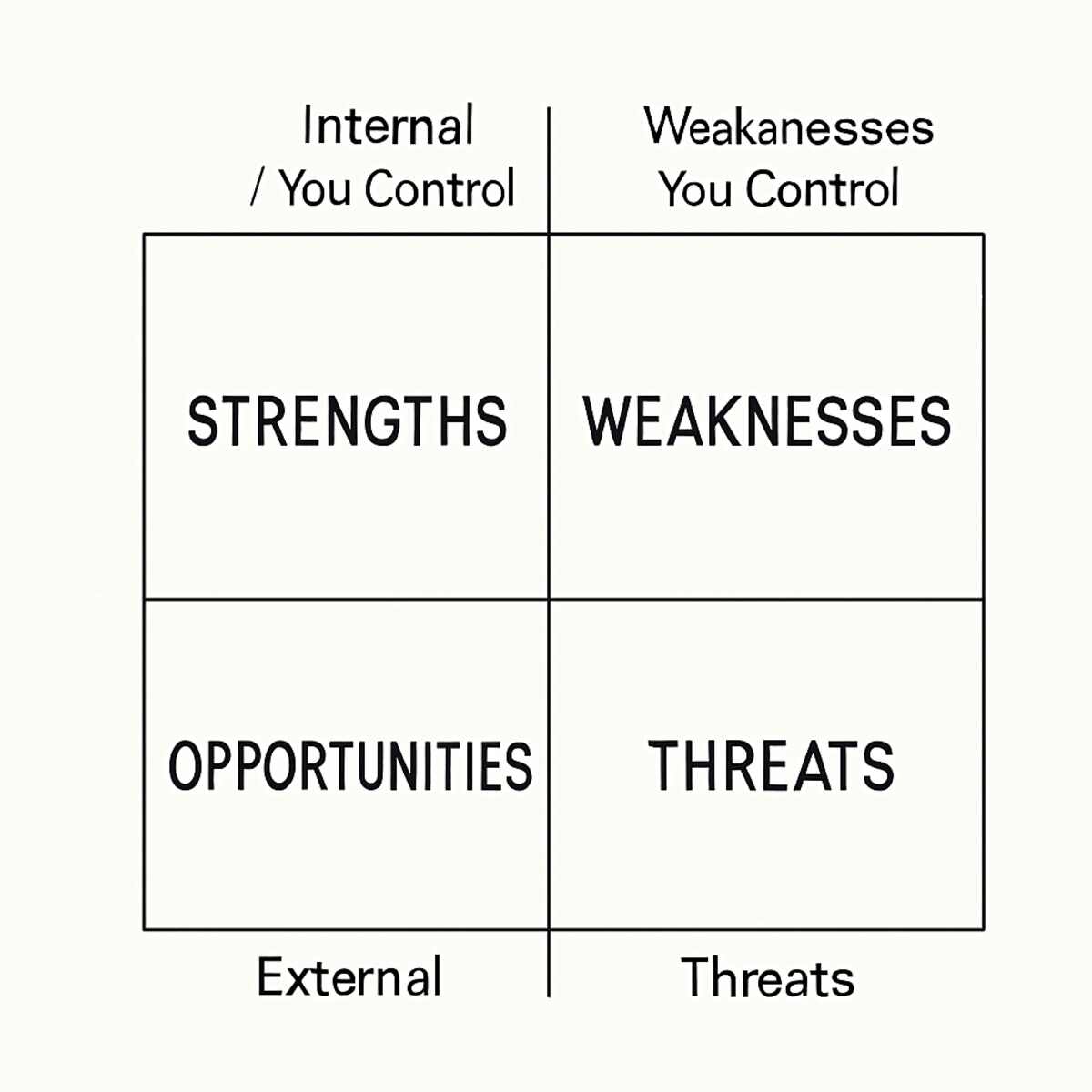
When you’re starting any project, from launching a side hustle to planning a career change, you first need a map of the territory. The most popular tool for this is the SWOT analysis, which is like a pro/con list on steroids. It gives you a quick, 360-degree view of where you stand by looking at four key areas: Strengths, Weaknesses, Opportunities, and Threats.
The real power of a SWOT analysis comes from how it organizes these four areas. Strengths and Weaknesses are internal factors—things you can directly control, like your skills or budget. Opportunities and Threats, on the other hand, are external—they are factors in the world around you that you can’t control, like market trends or a new competitor. This simple distinction helps you separate what you can change from what you must simply react to.
For example, imagine you want to start a podcast. A strength might be your great speaking voice (internal). A weakness could be your lack of audio editing skills (internal). An opportunity might be the growing popularity of podcasts in your niche (external), while a threat could be that a famous personality just launched a similar show (external).
In just a few minutes, this framework transforms a cloud of jumbled thoughts into a clear, organized snapshot. It doesn’t give you the answers, but it perfectly frames the situation so you can start asking the right questions. Now that you have a map of your situation, the next step is to figure out which specific problem you need to solve first.
How to Break Down Overwhelming Problems with an “Issue Tree”
A SWOT analysis helps you spot the big challenges, but some goals feel too massive to even start, like “increase revenue” or “find a new career path.” When faced with an intimidating problem, consultants use a visual tool called an Issue Tree to break it down into smaller, more manageable pieces, turning a giant question into a map of possible answers.
The secret to a useful issue tree is a simple organizational rule called the MECE principle (Mutually Exclusive, Collectively Exhaustive). It’s a fancy way of saying: cover all your bases, but with no overlaps. Imagine sorting laundry: you want to create piles (like “whites,” “darks,” and “delicates”) where every piece has a home, and no single item could belong in two different piles.
Let’s use this to tackle the goal “Save $5,000 for a vacation.” Applying the MECE principle, there are fundamentally only two ways to increase your savings:
- Option 1: Earn more money.
- Option 2: Spend less money.
These are the main branches of your tree. From here, you can add smaller branches. “Earn more” could split into “Ask for a raise,” “Freelance on weekends,” or “Sell old stuff online.” “Spend less” could become “Cancel unused subscriptions” or “Cook more meals at home.” Suddenly, that huge $5,000 goal isn’t one big problem—it’s a set of clear, actionable choices.
By deconstructing the problem, you’ve replaced a single source of anxiety with a menu of potential solutions. This clarity is half the battle. But now that you have a list of actions, a new question emerges: which one should you tackle first?
What Should I Do First? Prioritize Your Actions with an Impact/Effort Matrix
Your issue tree has given you a fantastic list of options, but it also creates a new challenge: decision paralysis. With ten different ways to save money, where do you even start? It’s tempting to just pick the easiest task, but that might not be the one that actually gets you closer to your vacation goal. What you need is a simple way to sort your ideas not just by what’s easy, but by what matters.
This is where a powerful consulting tool called the Impact/Effort Matrix comes in. Imagine drawing a large square on a piece of paper and dividing it into four smaller boxes. The line going up and down represents Impact (how much a task will help you reach your goal), while the line going side-to-side represents Effort (how much time or money it will take). You can now take every idea from your issue tree and place it into one of these four boxes, creating an instant visual map of your priorities.
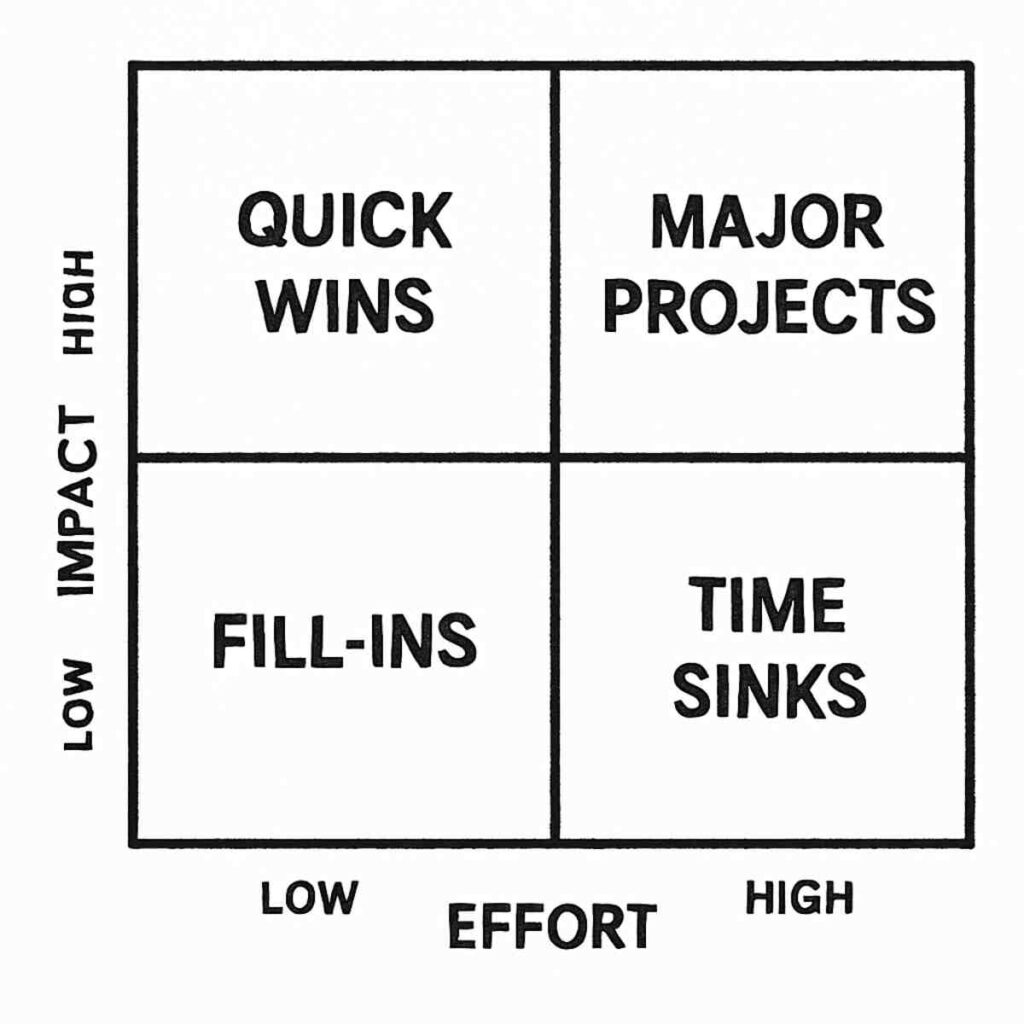
This simple map immediately reveals four types of tasks. High-impact, low-effort ideas are Quick Wins—like canceling unused subscriptions. Do these first to build momentum. High-impact, high-effort tasks are Major Projects, like finding a weekend freelance gig; they’re valuable but need planning. The most dangerous category is low-impact, high-effort: these are Time Sinks. They feel productive but drain your energy for little reward. By plotting your options, you can focus your energy on what works and actively avoid what doesn’t.
Suddenly, your chaotic list of “to-dos” becomes a clear action plan. You know what to tackle now (your Quick Wins) and what to plan for later (your Major Projects). This clarity is the key to turning good ideas into real results. Of course, once you’ve picked your priority, you often need to get other people on board with your plan.
How to Get Your Ideas Heard: The Pyramid Principle in 60 Seconds
Okay, you’ve picked your priority from the matrix. Now you need to convince your boss, your partner, or your team. The natural tendency is to start with all the background details, building your case like a mystery novel until you finally reveal your conclusion. But by the time you get to the point, you’ve probably lost your audience. There’s a much more effective way to be persuasive.
Top consultants flip this structure on its head using something called the Pyramid Principle. It’s incredibly simple: start with the answer first. State your main point or recommendation right at the beginning, like a newspaper headline. This immediately gives your audience a frame of reference for all the details that follow. They aren’t trying to guess where you’re going; they’re evaluating the support for a conclusion they already understand.
So how do you best support that main point? By leaning on the Rule of Three. Our brains are wired to find patterns, and grouping information in threes feels complete and memorable. Think of “ready, set, go” or “stop, look, and listen.” Instead of providing a laundry list of seven reasons, find the three most compelling arguments for your case. This forces you to be concise and makes your logic far easier to follow.
Putting it all together, a rambling request transforms into a sharp, persuasive pitch. Don’t say: “Our current system is slow, and Jane is complaining, and I saw an ad for this new tool…” Instead, try: “We should invest in the new software. It will solve our problem in three ways: it will save us time, reduce errors, and improve team morale.” This clear, structured communication is the final tool for turning your analysis into action.
Your New Thinking Process: From Overwhelmed to Organized in Three Steps
You’ve now seen a few of the core thinking tools consultants use. Their true power, however, doesn’t come from using them in isolation. The real magic happens when you chain them together into a reliable workflow that can be applied to almost any challenge, from launching a side hustle to planning a major life change. This process transforms that initial feeling of being overwhelmed into a structured, manageable plan of attack.
Instead of staring at a big, messy problem and not knowing where to begin, you now have a repeatable strategy to enhance your thinking. This problem-solving workflow gives you a clear path forward every time:
- Understand Your Situation: Start with a SWOT analysis to get a 360-degree view of the landscape. This is your “Where am I now?” step, mapping out the internal and external factors you’re dealing with.
- Break Down the Problem: Once you know your situation, use an Issue Tree to deconstruct your main goal or problem into smaller, bite-sized pieces. This is the “What could I do?” step, revealing all your possible paths.
- Decide What to Do First: Finally, take the options from your issue tree and plot them on an Impact/Effort Matrix. This is your “What should I do?” step, helping you instantly spot the quick wins and high-priority actions.
To make this feel less like theory and more like a real skill, try it out this week. Pick one small, nagging problem—like organizing your home office or figuring out a better morning routine. Walk through the three steps: map your situation (SWOT), break down the goal into tasks (Issue Tree), and prioritize what to do first (Matrix). You’ll be surprised how quickly a complex challenge becomes a simple to-do list.
Your Toolkit for Clarity: How Simple Frameworks Create Smarter Outcomes
That initial feeling of being overwhelmed by a complex problem doesn’t have to be your default anymore. You now possess a core consultant’s secret: a structured way to turn chaos into a clear plan. By understanding the situation, breaking the problem into smaller pieces, and prioritizing your actions, you can navigate any challenge with newfound confidence.
To make these practical thinking tools your own, start small. Pick a personal goal—like planning a weekend trip or learning a new skill—and sketch out a quick analysis on paper. This simple act is how you improve your problem solving, turning abstract concepts into a repeatable, personal process that builds real certainty.
Ultimately, this isn’t just about learning management consulting skills; it’s about changing how you see challenges. The next time you face a messy goal, you won’t see an insurmountable wall. You’ll see the first step. That’s the true power of your new toolkit—the ability to find a starting line for any finish line you can imagine.
