

Buried in a kitchen drawer or tucked away on a closet shelf, almost everyone has a simple deck of playing cards. That 52-card deck is a passport to hundreds of fun party games and quiet, competitive evenings. If you’ve ever heard of games like Hearts or Rummy but assumed the rules were too complicated, you’re not alone. Many classic card games aren’t truly unique; they fall into one of three simple categories based on a common goal. To learn more, check out Bti thể thao
By understanding the three core types of games—getting rid of your cards, collecting matching sets, or winning individual rounds—you’ll gain the confidence to pick up almost any card game. This guide reveals the simple “language” behind the cards, making any new game feel instantly familiar.
What’s in the Box? A Tour of Your 52-Card Deck
Before diving into any games, let’s get reacquainted with the 52 standard playing cards. The deck is split into four groups, called suits: two black suits (Spades ♠ and Clubs ♣) and two red suits (Hearts ♥ and Diamonds ♦). Each suit contains thirteen cards, identified by their rank—the number or letter on the card. This structure of four suits and thirteen ranks is the foundation for hundreds of different games.
Within each suit, the cards have a clear hierarchy. The number cards, from 2 through 10, are valued as you’d expect. Above them are the royalty, known as face cards: the Jack, the Queen, and the King. In almost every game, the King is the highest of this trio, followed by the Queen, and then the Jack.
Finally, there’s the Ace, the most versatile card in the deck. Its value changes depending on the game. When an Ace is the most powerful card, it’s called “Ace high”—a rule common in poker. In other games, it functions as the lowest card (like a 1), making it “Ace low.” Always check which rule a game uses before you start playing.
How to Properly Shuffle and Deal Like a Pro
A fair game starts with a good shuffle, and the most straightforward method is the overhand shuffle. Hold the deck face-down in one hand. With your other hand, use your thumb to slide a small packet of cards from the top into your palm. Repeat this motion, dropping small packets on top of each other, until the entire deck is in your other hand. Do this several times to ensure the cards are well-mixed.
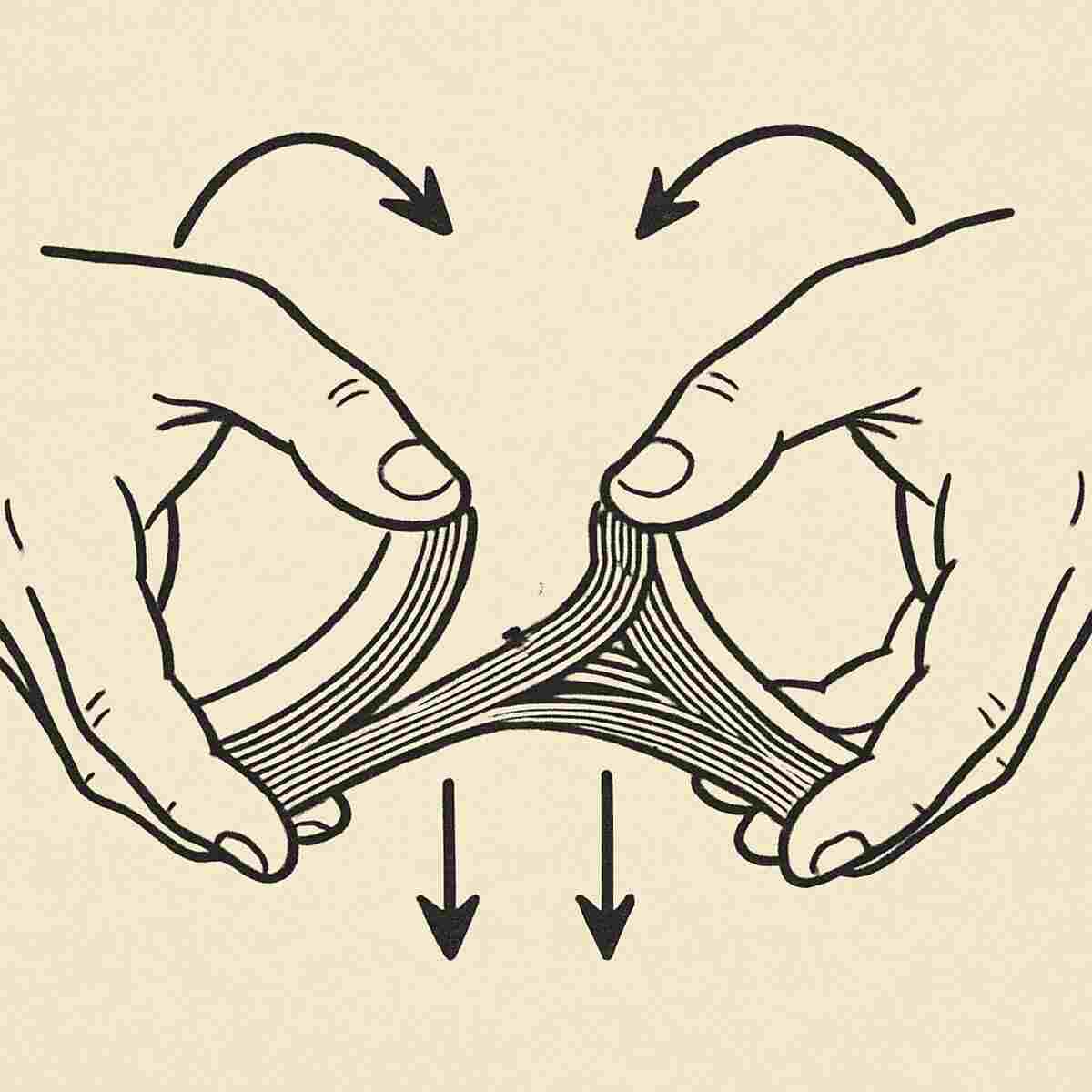
For a more thorough mix that looks impressive, you can try the classic riffle shuffle. Split the deck into two roughly equal piles. As the photo shows, grip the piles with your fingers on the outside and your thumbs on the inner edge. Gently bend the cards upward with your thumbs and let the corners cascade into each other, weaving the two halves together. With a little practice, it becomes the fastest way to get a truly random deck.
Once the deck is randomized, it’s time to deal. In most card games, the standard is to deal cards one at a time, face-down, starting with the player to your left. Continue dealing in a clockwise circle until everyone has the correct number of cards. This simple routine ensures no one gets an unfair advantage.
The Three Main ‘Goals’ in Card Games
Most card games fall into one of three main families, defined by their core objective. The simplest objective is to be the first person to empty your hands of all your cards. If you’ve ever shouted “Uno!” you know the thrill. With a standard deck, games like Crazy Eights belong to this category of shedding-type games, where the race is to get down to zero.
In contrast, some games reward you for collecting cards. In a game like Rummy, your goal is to form groups of matching cards called “melds”—either sets of the same rank or runs of the same suit. This style of game, known as melding, is all about carefully building your hand to create scoring combinations.
Finally, many classic card games are played in a series of mini-rounds. In these trick-taking games, like Hearts or Spades, each player plays one card to the center, and the highest card played wins the round, or “trick.” The game isn’t about your entire hand at once, but about strategically winning (or losing) these individual tricks to score points over time.
Learn in 5 Minutes: How to Play Crazy Eights
If you’re looking for the perfect entry into shedding-type games, look no further than Crazy Eights. The goal is simple: be the first player to get rid of all the cards in your hand.
The game revolves around a simple matching principle. Once the cards are dealt and the first card is flipped over to start the discard pile, the first player must play a card that matches the top card’s suit (e.g., Hearts on Hearts) or its rank (e.g., a King on a King). If you can’t make a match, you must draw a card from the deck.
The game gets its name from a special rule: the Eights are wild cards. You can play an 8 at any time, on top of any card. When you play an 8, you choose the suit the next player must match. This is your chance to change a suit you don’t have to one that fills your hand.
Here’s the flow of the game:
- Deal five cards (or seven for two players) to each person. Place the rest of the deck face-down as a draw pile.
- Flip the top card of the draw pile face-up to start the discard pile.
- Players take turns matching the top discard card by either suit or rank.
- If a player can’t play, they must draw from the deck. If that card is playable, they can play it immediately.
- The first person to empty their hand wins.
What Does It Mean to ‘Win a Trick’?
While some games are about emptying your hand, another family of card games is built around winning (or losing) “tricks.” A trick is a single round where every player plays one card. The first person to play a card is leading the suit. For instance, if they play a Diamond, they have led Diamonds for that trick.
The most important rule in these games is to follow suit. If you have a card of the suit that was led, you must play it. If the first player led with a Diamond, the next player must also play a Diamond if they have one. You can’t just play a Spade; you are locked into the suit that was led.
The player who played the highest-ranking card of the suit that was led wins the trick and collects all the cards played in that round. In our example, whoever played the highest Diamond takes the trick. This mechanic of leading, following, and winning tricks is the engine behind timeless classics like Spades, Bridge, and Hearts.
How to Play Hearts (and Avoid the Dreaded Queen of Spades)
Unlike many games where winning tricks is the goal, in Hearts your objective is to have the lowest score by avoiding tricks that contain “point cards.” At the end of a round, players tally the points from the tricks they’ve won.
So, which cards should you avoid? The game singles out two specific types of cards that carry points:
- Any Heart card = 1 point
- The Queen of Spades = 13 points
The Queen of Spades is worth more than all the Hearts combined, making her the most feared card in the deck. Thankfully, before the first trick, each player chooses three cards to pass to an opponent, giving you a chance to get rid of high-ranking Spades or Hearts.
A crucial rule is that you can’t lead a trick with a Heart until Hearts have been “broken.” This happens when a player, unable to follow the led suit, discards a Heart into the trick. Only after a Heart has been played this way can players begin leading tricks with Hearts.
Understanding ‘Melds’ for Rummy and Other Games
While some games are about avoiding cards, melding games challenge you to collect them. Your primary goal is to organize the cards in your hand into specific scoring groups known as melds. Learning to spot potential melds is the first step toward mastering a huge category of classic card games.
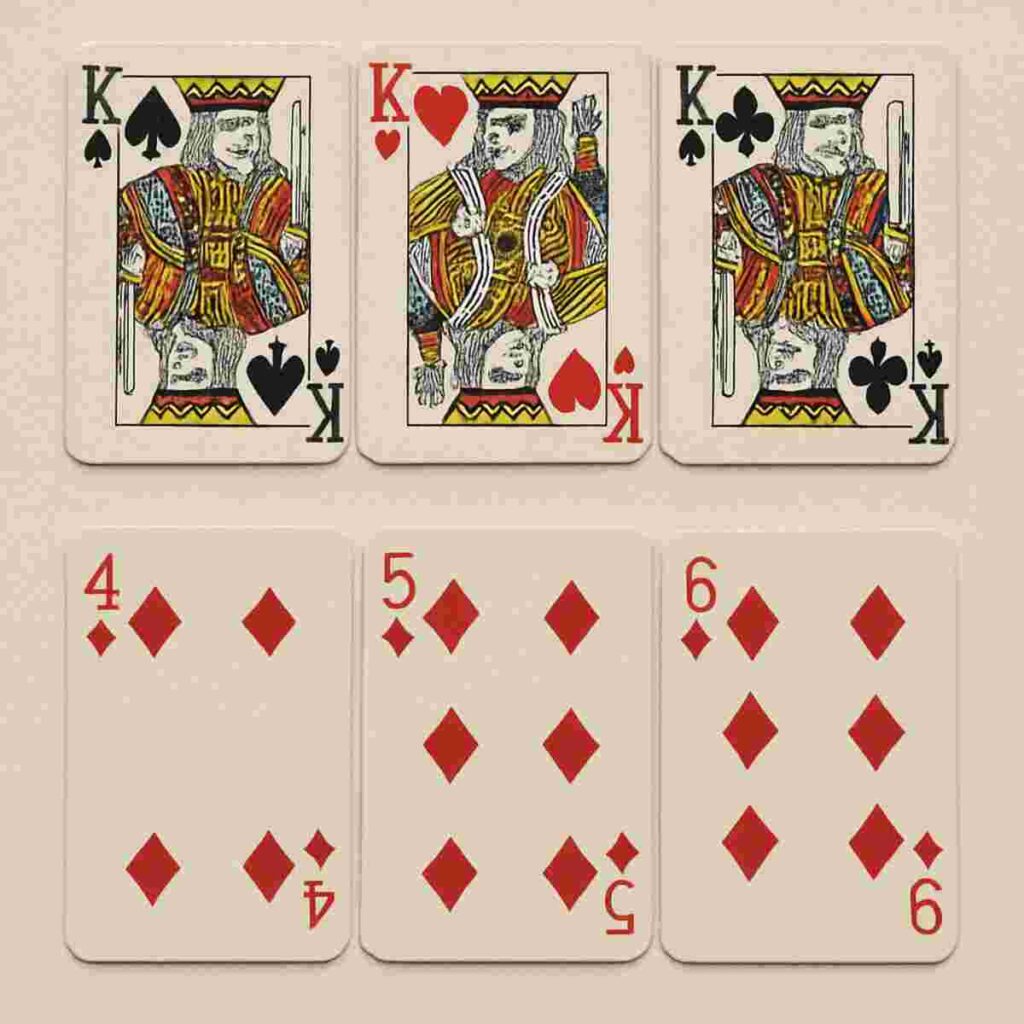
Melds come in two simple varieties. The first is a Set, a group of three or four cards of the same rank but different suits—for example, the King of Spades, King of Hearts, and King of Clubs. The second type is a Run, which consists of three or more cards of the same suit in sequence, such as the 4, 5, and 6 of Diamonds. As you can see in the image, one is about matching ranks, while the other is about creating a suited sequence.
Mastering the art of spotting and building these combinations is the key to winning many popular card games, including Rummy.
Your First Hand: The Rules for the Game of Rummy
The game of Rummy has a simple, repeating rhythm. On your turn, you must first draw one card, either the unknown top card from the stock pile or the known top card from the discard pile. This choice is your first strategic decision.
After you draw, you can lay down any completed melds (sets or runs) from your hand. You don’t have to, but placing melds is how you get closer to winning. To end your turn, you must discard one card face-up onto the discard pile, making it available for the next player.
The goal is to be the first player to get rid of every card in your hand, known as “going out.” This usually happens by melding your cards over several turns. A more dramatic win is “Going Rummy,” where you form your entire hand into melds and lay them all down in a single turn.
This simple cycle of draw, meld, and discard makes Rummy easy to pick up. The blend of luck from the draw and the skill of deciding what to keep and what to discard makes it one of the best family card activities.
Poker Hand Rankings Explained, From High Card to Royal Flush
Many card games use a fixed hierarchy of hands to decide which is best. This system, the poker hand rankings, is the foundation for countless games. The core idea is simple: the rarer the hand, the more powerful it is. For example, a Flush (five cards of the same suit) is harder to get than a Straight (five cards in numerical sequence), so a Flush always beats a Straight.
If two players have the same hand, like One Pair, the “kicker” decides the winner. The kicker is your highest side card that isn’t part of the combination. If you and an opponent both have a pair of Aces, but your next-highest card is a King, and theirs is a 10, your King “kicker” wins.
The official poker hand rankings from best to worst are:
- Royal Flush (A-K-Q-J-10 of the same suit)
- Straight Flush (Any five cards in sequence of the same suit)
- Four of a Kind (e.g., four Queens)
- Full House (Three of a Kind plus a Pair)
- Flush (Any five cards of the same suit)
- Straight (Any five cards in sequence, mixed suits)
- Three of a Kind (e.g., three 7s)
- Two Pair (e.g., two Jacks and two 8s)
- One Pair (e.g., two Kings)
- High Card (If no one has a pair or better, the highest single card wins)
How to Play Classic Solitaire (Klondike) by Yourself
While many card games are about outplaying friends, classic Solitaire is a rewarding challenge for one. The familiar setup involves dealing cards into seven columns, with the first having one card and the last having seven. Only the top card of each column is turned face-up.
The main playing area is called the tableau. Your goal is to uncover the face-down cards within it. The rest of the deck, the stockpile, provides new cards when you run out of moves. Managing the tableau and stock is the core strategic decision.
Progress in Solitaire depends on one rule: build sequences downward in alternating colors. For example, place a red 9 on a black 10. You can also move entire sequenced stacks together. Each time you move a face-up card, you flip over the card beneath it.
The ultimate goal is to build four foundation piles, one for each suit, starting with an Ace. From there, you build up in ascending order (Ace, 2, 3… King). Once all 52 cards are moved from the tableau and stock to their foundation homes, you’ve won.
The Best Popular Card Games for Two Players
After mastering a solo game, the next step is a great game for two. Some of the most popular card games are designed for this head-to-head dynamic.
For a burst of frantic energy, look to Spit. There are no turns; it’s a pure race to empty your hand. Players frantically place cards onto central piles, building sequences up or down (a 7 on a 6 or 8, for example). The first to play all their cards from their personal pile wins the round.
If you prefer strategy over speed, Gin Rummy is a classic. Like other Rummy games, the goal is to form sets and runs. The key twist is that you can end the round early if your unmatched cards—known as deadwood—have a low point value. This adds a layer of risk: aim for a perfect hand, or end the round quickly to catch your opponent with high-value deadwood?
What to Play with a Big Group: Fun Party Games for All Ages
When your game night grows, you need an activity that thrives on chaos, and Spoons is a perfect choice. In this frantic game, players pass cards around, all trying to collect four of a kind. The first person to do so quietly grabs a spoon from a pile in the center, signalling a mad dash. With one fewer spoon than players, the person left empty-handed is out.
If you prefer cunning deception, Cheat is an excellent family game. Your goal is to get rid of cards by playing them face down while declaring their rank, like “two Jacks.” You can lie. Any other player can challenge you by yelling, “Cheat!” If they catch your bluff, you take the discard pile. But if you were honest, your accuser gets stuck with the cards instead.
These party games succeed because they focus on social interaction over complex rules. The goal isn’t deep strategy but generating laughter and memorable moments.
Beyond Klondike: Two Great Solitaire Alternatives
If you’ve spent hours on classic Solitaire, you might be ready for a new challenge. One popular alternative is Spider, which feels bigger and more complex. Instead of four foundations, your goal is to assemble entire suits (King down to Ace) directly within the main playing area. Using two decks, you navigate a web of columns. For an easier start, play with just one suit before tackling the difficult four-suit version.
For players who prefer pure logic, FreeCell is the perfect fit. Every card is dealt face-up from the start. Your advantage comes from four “free cells,” which act as temporary holding spots. You can move any single card to a free cell to uncover the card beneath it. Because you have all the information, nearly every game of FreeCell is solvable, turning it into a true mental puzzle.
A Quick History: Where Did the 52-Card Deck Come From?
The design of modern playing cards was largely standardized in 15th-century France. French card-makers simplified earlier designs, creating the familiar Spades, Hearts, Diamonds, and Clubs. A popular theory suggests these suits represented the four major classes of French society: Spades for the nobility’s pikes, Hearts for the church, Diamonds for wealthy merchants, and Clubs for peasants.
The symbolism might go even deeper. Many believe the deck was designed as a kind of almanack. The 52 cards match the 52 weeks in a year. The four suits align with the four seasons, and the thirteen cards in each suit correspond to the thirteen lunar cycles. The two colors, red and black, could signify day and night.
When you shuffle, you’re holding a small piece of history—a miniature calendar that has entertained people for centuries.
Your Card Game Adventure Starts Now
That simple deck of cards on your shelf is no longer a mystery. You now see a toolkit for fun. You understand the difference between shedding games like Crazy Eights, melding games like Rummy, and trick-taking games like Hearts. You’re ready to deal.
The best way to learn is to play. Grab that deck, find a friend or family member, and deal a hand of Crazy Eights tonight. Your first round will prove how simple it is to turn a quiet evening into a memorable one.
Every shuffle is a chance to put screens away and reconnect. You aren’t just playing a game; you are building memories, one laugh and one friendly challenge at a time.
