


We have all felt the fleeting thrill of a bargain t-shirt, only to watch it lose its shape after just a few washes. While the staggering price tags of luxury fashion brands often spark debate, looking past the sticker shock reveals a hidden environmental calculation that many shoppers overlook. Find the luxury designer brands.
Fast fashion operates much like a sugar rush, prioritizing speed and volume for items often destined for a landfill within a year. By contrast, the rising movement of “slow fashion” focuses on heavy craftsmanship and longevity, treating a coat or bag as a permanent wardrobe resident rather than a temporary guest.
Durability serves as the first and most effective line of defense for the planet. A hand-stitched leather tote that withstands two decades of daily wear ultimately demands far fewer resources than the cycle of manufacturing and shipping a cheap synthetic replacement every winter.
Research indicates that extending the active life of a piece of clothing by just nine months can reduce its carbon, water, and waste footprints by nearly 30 percent. Heritage brands rely on this logic, often selling the idea that you never actually “own” their products, but merely look after them for the next generation.
Status is no longer defined solely by logos, but increasingly by the ethics behind the manufacturing. Exploring sustainable practices in high-end fashion helps us understand that the ultimate luxury is not just exclusivity, but the ability to buy less by buying better.
The ‘Heritage’ Advantage: How 100-Year-Old Traditions Pre-Date Modern Waste
Although we often associate luxury with excess, the traditional methods used by a legacy fashion label are actually accidental champions of sustainability. Before “eco-friendly” became a marketing buzzword, high-end houses operated on a model of slow, deliberate creation simply because that was the only way to ensure perfection. The history of heritage fashion houses reveals that their production cycles were naturally limited by the speed of human hands rather than the capacity of machines.
Consider the leather workshops of Tuscany or the textile mills of Lyon, where production is clustered in specialized regional hubs. These areas rely on artisan techniques that inherently limit waste through precision. Instead of massive automated cutters slicing through layers of fabric and discarding the scraps, a skilled craftsperson cuts distinct pieces for specific orders. This “made-to-order” mindset means materials are often only consumed when a customer is waiting, effectively eliminating the mountains of unsold inventory that plague the fast-fashion industry.
There is also a distinct mechanical logic to how these items are built: they are designed to be repaired, not replaced. A luxury shoe, for instance, often uses a construction method like Goodyear welting—a strip of leather stitching the upper part to the sole—which allows a cobbler to replace the bottom repeatedly without damaging the shoe’s structure. When you buy a heritage piece, you are effectively buying a lifetime subscription to that object, keeping it out of the landfill for decades.
Not all luxury operates on this intimate, sustainable scale anymore. As these historic houses expanded into global empires, they had to balance their hand-crafted roots with the demands of the modern market. This necessitates a crucial comparison regarding environmental impact: Haute Couture vs. Ready-to-Wear.
Haute Couture vs. Ready-to-Wear: Which Scale is Better for the Earth?
While many of us use the term “Haute Couture” to describe any expensive dress, the industry distinction is strict and vital for sustainability. Think of Haute Couture like a commissioned portrait painted just for you, whereas Ready-to-Wear (Prêt-à-Porter) is a high-quality print sold in a gallery. True couture from top French couture houses creates almost zero excess inventory because a garment generally doesn’t exist until a specific client orders it.
In contrast, Ready-to-Wear introduces the gamble of prediction. Brands must manufacture thousands of coats in sizes XS through XL, hoping they sell before the season ends. When those sales don’t happen, the result is “deadstock”—unsold inventory that sits in warehouses. While fast fashion might burn this excess to protect brand exclusivity, luxury houses are increasingly under pressure to repurpose these leftovers rather than destroy them.
The logistical differences between these two tiers create vastly different environmental footprints:
- Inventory Risk: Couture holds zero finished stock; RTW holds seasonal inventory that risks becoming obsolete.
- Fabric Efficiency: Couture cuts fabric to exact measurements (Made-to-Measure); RTW uses standardized patterns that inevitably leave scraps.
- Lifecycle: Couture is built to be altered and passed down as an heirloom; RTW is more likely to eventually enter the donation cycle.
Ultimately, the most sustainable choice involves stripping away the hype of seasonal trends entirely. This shift toward timelessness explains why “Quiet Luxury” is the most sustainable trend you’ll ever follow.
Why ‘Quiet Luxury’ is the Most Sustainable Trend You’ll Ever Follow
We often associate wealth with flashy logos or gold buckles, but “Quiet Luxury” focuses on the whisper rather than the shout. This aesthetic prioritizes unbranded, neutral staples—like a perfect cashmere sweater or a structured wool coat—where the value lies entirely in the fabric quality and the cut. By removing the “status symbol” aspect, you focus on garments that won’t look outdated when the next micro-trend takes over social media.
Rejecting the seasonal “trend cycle” is effectively the most eco-friendly choice a consumer can make. Instead of chasing a specific print that will look dated in six months, proponents of this style curate a “capsule wardrobe” of high-quality essentials designed to last for decades. This shift toward “forever” aesthetics prevents the constant closet churn that fills landfills, turning fashion into a long-term partnership rather than a fleeting fling.
The best way to justify the higher upfront price of these staples is a metric called Cost Per Wear (CPW). While a $50 trendy shirt worn twice costs you $25 per use, a $500 investment piece worn 250 times costs you only $2 per wear. Viewing your wardrobe through this mathematical lens transforms high price tags from frightening expenses into rational investments in durability.
Longevity, however, requires more than just a timeless look; it demands materials that can physically survive years of daily use. A design might remain stylish forever, but it needs superior construction to hold its shape, a standard that is rigorously maintained by the masters of Italian craftsmanship.
The Master’s Touch: Why Italian Craftsmanship is a Blueprint for Ethical Leather
When you pick up a high-end leather bag, that distinct, earthy aroma is usually the result of vegetable tanning. Unlike the harsh chemicals used in fast-fashion production, this centuries-old Italian technique uses natural tannins found in tree bark and leaves to preserve the hide. The process takes weeks rather than hours, resulting in a material that is breathable, biodegradable, and develops a unique sheen—or “patina”—over time, much like how an antique wood table grows more beautiful with age.
Beyond the chemistry, the “Made in Italy” label serves as a rigorous standard for human rights. In a global industry often plagued by opaque supply chains, strict European labor laws ensure that the artisans cutting and stitching your goods are paid fair wages and work in safe environments. You aren’t just paying for the brand name; you are funding a protected ecosystem that values the craftsman’s livelihood as much as the final product.
It is also crucial to distinguish these heritage materials from the marketing buzzword “vegan leather.” While innovative plant-based options exist, most entry-level vegan alternatives are simply polyurethane—plastic sheets that eventually crack, peel, and sit in landfills for centuries. In contrast, traditional leather utilizes a byproduct of the food industry, transforming what would otherwise be waste into a durable, biodegradable luxury good.
To ensure your investment supports these ethical standards and genuine quality, look for specific verification seals inside the product:
- Pelle Conciata al Vegetale in Toscana: Guarantees traditional vegetable tanning methods.
- ICEC: The Institute of Quality Certification for the Leather Sector in Italy.
- UNI 11239: Certifies the full traceability of the finished leather product.
Beyond the tangible journey of leather lies the complex ethics of silk and cashmere.
Ethical Sourcing: The Hidden Journey of Your Silk and Cashmere
While the weight of leather commands attention, the delicate touch of silk and cashmere often hides a heavy environmental footprint. Conventional farming for these fibers can exhaust the land, prompting forward-thinking luxury fashion brands to embrace “regenerative agriculture.” Think of this method as a restorative spa treatment for the earth; instead of stripping nutrients from the soil with pesticides, these farms use natural cycles to actually improve soil health and biodiversity while growing their crops.
Cashmere sourcing faces a similar crisis, where the demand for cheap sweaters has led to massive goat herds turning Mongolian grasslands into deserts through overgrazing. Ethical sourcing in the premium apparel market now focuses on “grazing management,” ensuring herds are small enough to allow the grass to grow back. When you invest in high-end knitwear, the higher cost often funds these strict limits that prevent the fabric’s source from disappearing entirely.
To strictly enforce these standards, many “Maisons” are now buying the farms themselves, a strategy called supply chain verticalization. It is comparable to a Michelin-star chef purchasing their own vegetable garden to ensure every ingredient meets their exact standards. By owning the entire process from the pasture to the boutique, brands can eliminate the “middlemen” who might cut corners, guaranteeing that the materials are as pure as the design.
Recognizing the immense effort required to produce these sustainable fibers explains why they are built to last decades rather than seasons. This intrinsic value, born from the soil itself, is exactly what allows specific luxury items to become financial assets rather than mere clothing.
The Resale Goldmine: Why Iconic Handbags are Better Than Gold
Most clothing loses half its value the moment you cut the tags, but specific luxury goods defy this rule. Because brands like Hermès or Chanel use those durable, ethically sourced materials, their products don’t just survive; they often appreciate. In financial circles, this is known as “asset-class fashion,” where a handbag acts less like a simple accessory and more like a stock certificate you can carry on your arm.
Scarcity drives this market; when a “Maison” limits production to maintain quality standards, the secondary market becomes the only way to bypass years-long waitlists. This vibrant resale culture creates a “circular economy”—a system where high-quality items are circulated among owners for decades rather than ending up in a landfill. Unlike fast fashion, which is designed to be disposable, a well-made luxury item retains both its utility and its worth through multiple lifecycles.
If you are looking to make a purchase with future resale value in mind, market history suggests these icons perform best:
- Hermès Birkin: The “holy grail” that has historically outperformed gold and the S&P 500.
- Hermès Kelly: A structured classic with consistently high demand.
- Chanel Classic Flap: Retail price hikes occur annually, pulling used prices up with them.
- Louis Vuitton Neverfull: A practical staple that retains significant value.
- Lady Dior: A heritage piece that serves as a steady, long-term store of value.
Viewing your wardrobe as a portfolio rather than a consumption habit encourages buying fewer, better things. However, as resale prices climb, so does the incentive for dishonesty. To protect your investment, you must learn to distinguish genuine value from marketing tricks.
How to Spot a ‘Green’ Fake: Identifying Authentic Sustainable Luxury
Protecting your investment requires vigilance, especially since the counterfeit market is essentially unregulated fast fashion. Fakes don’t just hurt luxury fashion brands‘ reputations; they bypass the environmental standards that justify the high price tag, often relying on toxic dyes and exploitative labor. When you unknowingly buy a counterfeit, you aren’t just losing resale value; you are funding the very pollution and waste that genuine luxury aims to reduce through longevity.
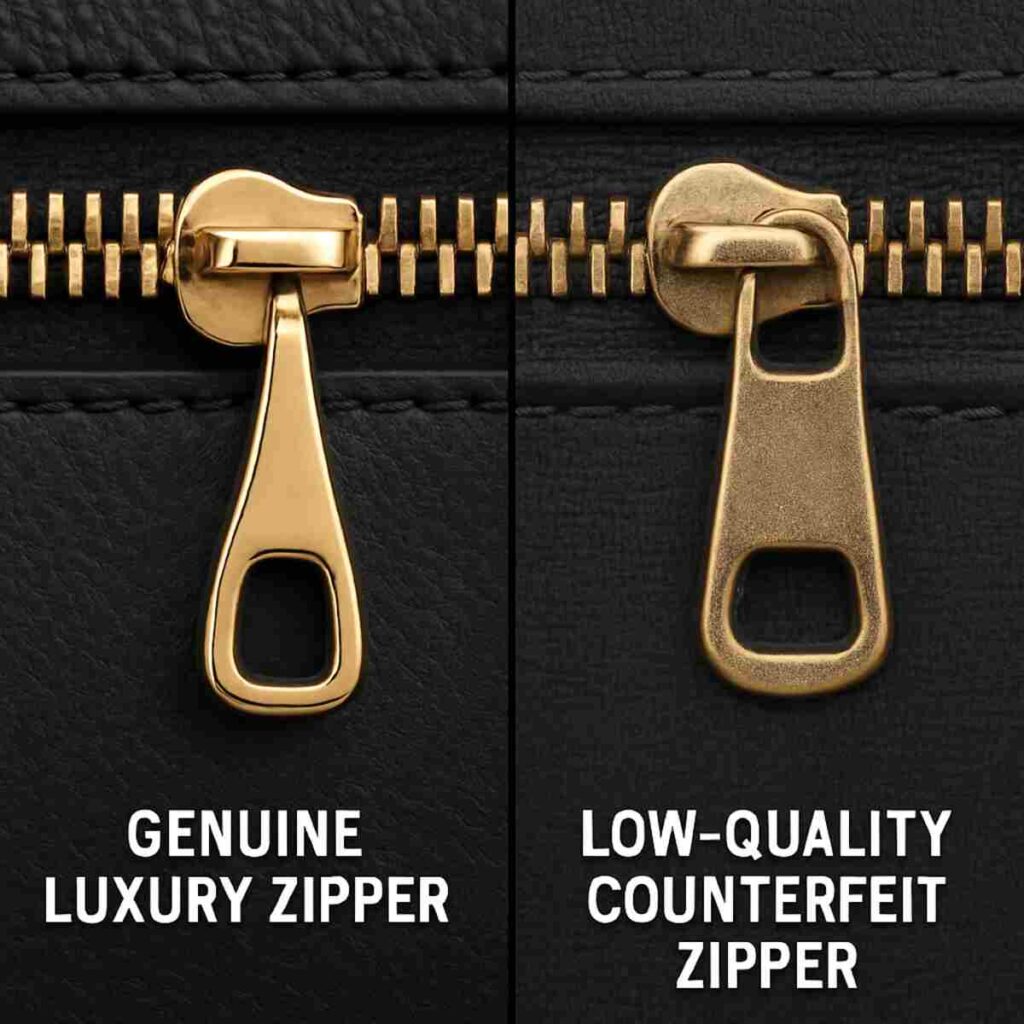
![Image: A split-screen close-up comparison. On the left, a “Genuine” zipper features polished, heavy brass teeth and consistent fabric tape. On the right, a “Counterfeit” zipper shows shiny, hollow plastic teeth and uneven stitching on the tape.]
Before relying on technology, trust your senses to differentiate a master craftsman’s work from a mass-produced copy. When learning how to identify authentic designer clothing, look for these tactile clues:
- Zipper weight: Luxury hardware is solid brass or coated metal that glides smoothly, while fakes feel hollow and often stick.
- Stitch count: Authentic items feature tight, angled stitching (like saddle stitching) rather than straight, loose machine lines.
- Lining texture: The interior should feel as substantial as the exterior, avoiding the crinkly “plastic” sound of cheap synthetics.
Beyond physical inspections, the industry is adopting “Digital Passports” to guarantee provenance. Brands like LVMH and Prada now use blockchain technology—essentially a digital, unhackable ledger—to create a “digital twin” for physical products. This allows you to scan a tag and see the item’s entire journey, from the Italian workshop to the store shelf, proving it isn’t a factory reject or an unauthorized copy.
Verifying authenticity ensures your money supports skilled artisanship rather than landfill-bound imitations. As technology merges with tradition, these digital tools are moving upstream to minimize waste before a single piece of fabric is cut.

The Digital Revolution: How VR and AI are Cutting Carbon in the Atelier
While verifying authenticity protects the final product, the impact of digital transformation on couture tackles the massive amount of waste created before a design is even approved. Traditionally, a Creative Director might demand twenty physical variations of a single coat to test different fabrics and fits, requiring samples to be flown back and forth between design studios in Paris and factories in Italy. This rigorous trial-and-error process burns jet fuel and scraps yards of premium textiles for garments that will never be worn.
Modern fashion houses are increasingly swapping muslin prototypes for high-fidelity 3D renders to eliminate this physical waste. Just as an architect renders a virtual building to test light and structure before laying a single brick, designers now use advanced simulation software to visualize exactly how a heavy velvet or a light chiffon will drape on a moving avatar. This allows the atelier to perfect complex patterns and adjust hemlines digitally, ensuring that physical fabric is cut only when the design is finalized.
Artificial Intelligence further refines this efficiency by introducing predictive demand modeling to replace expensive guesswork. Instead of manufacturing thousands of items based on a hunch and risking unsold inventory, brands analyze real-time data to produce exactly what the market desires. This precision prevents the creation of “dead stock,” ensuring that luxury remains rare and purposeful rather than mass-produced and discarded.
By moving the messy drafting phase into the virtual world, the industry is proving that high-tech tools can actually preserve traditional craftsmanship while drastically shrinking the environmental cost. This shift toward intentional, data-backed production sets the stage for a broader cultural shift evident in streetwear’s sustainable makeover.
Streetwear’s Sustainable Makeover: From Hype to High-End Durability
Streetwear has historically been defined by the “drop”—a marketing tactic where limited-edition items sell out in seconds, fueling a cycle of frantic consumption. This model often prioritizes the thrill of the chase over the longevity of the garment, leading to closets full of trendy items that lose value once the hype fades. However, a significant shift is occurring as luxury fashion brands begin to treat these casual staples with the same reverence usually reserved for Italian suits.
Major labels are responding to eco-conscious consumers by integrating “circular” design principles, effectively turning waste into wealth. Instead of relying on cheap, virgin synthetics, designers are increasingly utilizing materials like ECONYL—a nylon regenerated from ocean plastic—to craft high-end windbreakers that are virtually indestructible. This evolution of streetwear in the high-fashion industry moves the focus from owning the newest logo to investing in pieces built to survive decades of wear.
Elevating construction standards challenges the assumption that casual clothing is inherently disposable. When a sweatshirt is constructed from heavyweight, organic cotton and stitched with the precision of a couture gown, it stops being fast fashion and becomes a “future vintage” item. This approach ensures that the garment serves as a long-term wardrobe foundation rather than a fleeting social media prop.
Transforming urban staples into sustainable heirlooms requires sourcing premium materials and paying fair wages for skilled labor, inevitably driving up the sticker price. Understanding the economics behind these choices defines “The Price of Perfection.”
The Price of Perfection: Why Ethical Luxury Actually Costs More
When we see a four-figure price tag on an eco-friendly garment, the immediate reaction is often skepticism. Consumers frequently ask why are designer goods so expensive, assuming the markup is purely for marketing or prestige. However, the reality is that cheap clothing is often artificially subsidized by exploitative wages and environmental neglect, while ethical production reflects the true financial requirements of making things well.
Fair labor is the most significant driver of this cost difference. While fast fashion chases the lowest legal minimum wage globally to keep prices down, true luxury involves paying a “living wage”—an income that covers distinct needs like housing, healthcare, and education for the worker’s family. This shift treats garment making as a respected career rather than disposable labor, ensuring that the hands stitching your jacket are valued as highly as the jacket itself.
To visualize where the money goes, consider the breakdown of a basic staple:
- The $20 Fast Fashion Tee: $1 low-wage labor + $2 synthetic fabric + $0 pollution control + $17 profit and overhead.
- The $300 Ethical Luxury Tee: $65 skilled artisan wages + $50 organic cotton + $40 non-toxic dye processing + $145 operational costs and reinvestment.
Beyond wages, luxury fashion brands are increasingly adopting strict ESG (Environmental, Social, and Governance) standards that mandate expensive, non-toxic manufacturing processes. Filtering wastewater so it returns clean to nature is costly, but it prevents the heavy ecological debt that cheap dyeing creates. Understanding these economics helps us see purchases not as spending, but as curating, which leads us to the concept of building a conscious archive.
Building Your Conscious Archive: A Roadmap for the Future
You no longer see a high price tag as just an arbitrary number, but as a summary of heritage, materials, and skilled labor. By understanding the “why” behind the cost—from the ethical sourcing of raw materials to the decades of brand history—you have gained the fashion literacy needed to distinguish true value from mere hype. You can now walk into any boutique and look past the lighting and celebrity endorsements to judge the craftsmanship for yourself.
Apply the “Conscious Archive” strategy to your own closet. Instead of viewing luxury fashion brands as producers of fleeting status symbols, treat them as partners in building a personal legacy. This mindset shifts you away from fast fashion’s disposable culture and toward a curated collection of investment pieces for a designer wardrobe that will stand the test of time.
Before you make your next significant purchase, run the item through this sustainable luxury checklist:
- Check the Composition: Prioritize natural fibers like wool, silk, or leather over synthetics.
- Verify the Origin: Does the “Made In” label match the brand’s specific area of expertise?
- Test the Hardware: Ensure zippers and clasps feel heavy and operate smoothly.
- Assess Longevity: Ask yourself, “Will this silhouette still be relevant in ten years?”
- Calculate Cost-Per-Wear: Determine if the price justifies the frequency of use.
As the industry embraces digital innovation, your ability to verify authenticity and track sustainability will only improve. New tools like digital product passports are making it easier to ensure your investment supports ethical craftsmanship rather than just empty marketing.
Ultimately, the smartest luxury consumer isn’t the one with the most logos, but the one with the most discernment. Face the investment dilemma with confidence: choosing one impeccably crafted item that lasts a lifetime is always more stylish—and sustainable—than buying five “okay” things that fade with the season.