


Tired of fetching drinks? There’s no worse feeling in a game of Scum than finishing last and hearing everyone gleefully shout your new title. You stare at the lousy cards you were dealt, convinced it was all just bad luck and that your fate was sealed from the start. To learn more, check out gamestopgiftbalance.com
But what if the cards you’re dealt matter less than how you play them? While luck certainly gets you started, experienced players know a secret: the winner is often the person who best controls the flow of the game, not the one with the best hand. Learning how to win at Scum is about shifting your focus from hoping for good cards to making smart moves with the ones you have.
This doesn’t require you to become a card shark or memorize complicated strategies. In practice, just a few core principles can completely transform your results. You don’t need to track every card played or calculate complex odds; the goal here is to provide simple, actionable advice you can use in your very next round to immediately play better.
These fundamentals will help you manage your hand, take control at critical moments, and, most importantly, show you how to not be the Scum again.
The Only 3 Rules You Really Need to Remember
First, let’s lock down the absolute basics. Unlike poker, the goal in Scum isn’t to build the best hand—it’s to get rid of all your cards before anyone else. The last person holding cards becomes the “Scum” for the next round, which is exactly what we’re trying to avoid. Your entire strategy should revolve around this one simple objective: empty your hands as efficiently as possible.
With that goal in mind, you need to know which cards are your workhorses and which are your dead weight. The card ranking in Scum is straightforward: 3 is the lowest card, and the value climbs up from there (4, 5, 6…) all the way to the King and, finally, the Ace as the highest. This means a single 8 can be played on a 7, a pair of Queens on a pair of Jacks, and so on.
Finally, there’s one card that breaks all the rules: the 2. Think of the 2 as your ultimate “reset button.” A single 2 is the most powerful card in the game; it can be played on anything—even four Aces—and it instantly clears the pile. The player who throws the 2 wins the trick and gets to lead the next play. This power to clear the board and seize control is the secret to going from Scum to President.
Why ‘The Lead’ Is the Single Most Important Thing to Control
We mentioned that a 2 lets you “seize control,” and this brings us to the most crucial strategy in Scum: getting and keeping the lead. The lead is simply the power to play first in a new trick. Think of it as having the remote control for the game—whoever has it decides what everyone gets to watch. When you have the lead, you are in the driver’s seat.
The reason this is so powerful is that the player with the lead dictates what type of card combination must be played. If you start a trick by playing a single 4, everyone else must also play a single card. If you lead with a pair of 8s, everyone else has to follow with a pair. This allows you to play to your hand’s strengths and force your opponents to play on your terms.
So, how do you capture this game-changing advantage? There are two primary ways. The first is to win a trick by playing the highest card, forcing everyone else to pass. For example, if someone plays a King, you can play an Ace to win the trick and take the lead. The second, more dramatic way is to clear the pile entirely, usually by playing a 2.
Getting the lead is half the battle. Once you have it, you have a golden opportunity to get rid of your most troublesome cards and put serious pressure on the other players. But you have to use it wisely.
The #1 Trick: How to Use the Lead to Get Rid of Your Worst Cards
You’ve won the trick and now have the lead. Congratulations! The temptation might be to slam down a powerful pair to show you mean business. But the smartest move is often the opposite. The single best strategy for using the lead, especially early in the game, is to get rid of your worst card. This is a tactic called shedding.
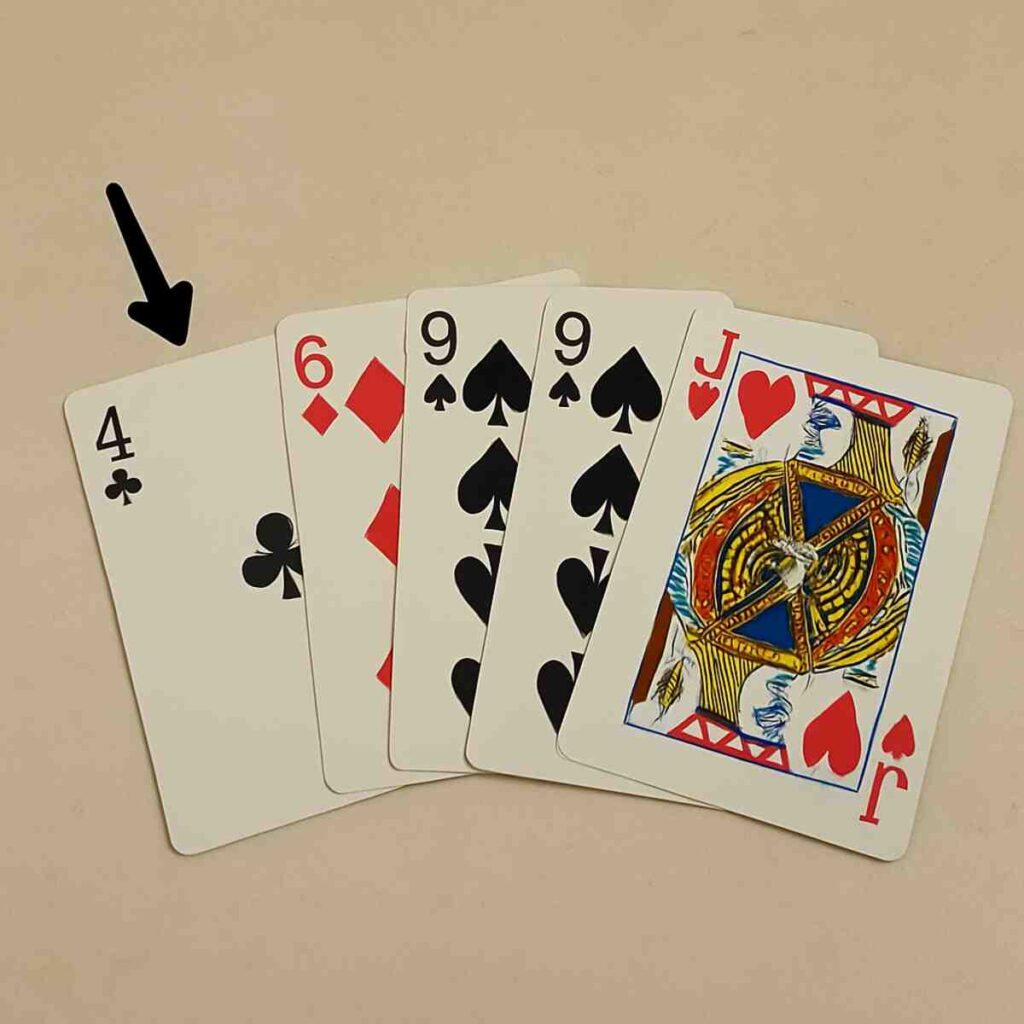
Look at your hand and find your loneliest, lowest-ranking single card—that 4, 5, or 6 that isn’t part of a pair—and play it. Those low single cards are like junk mail in your hand. They can’t win a trick on their own and are incredibly difficult to play when someone else is leading with pairs or high cards. By using your lead to play a single low card, you force everyone else to play a single card as well. You’ve just successfully turned your position of power into a garbage disposal for one of your weakest cards, instantly making the rest of your hand stronger and more flexible.
Imagine your hand is a 4, a 6, a pair of 9s, and a pair of Jacks. If you gain the lead, playing the 4 is your best move. Now your hand is just the 6 and two powerful pairs. You’ve cleverly avoided the dreaded scenario where you’re left with just that unplayable 4 at the very end. Of course, this strategy is easy when you have a clear junk card to shed. But what do you do when your only path to grabbing the lead involves breaking up one of your own good pairs?
When to Break Up a Good Pair to Steal the Lead
It feels counterintuitive, doesn’t it? We’re taught to collect and protect our powerful pairs. But the smartest Scum players know that a card’s value isn’t fixed. Sometimes, a single King is more powerful than a pair of Queens—if that one King can win you the lead when it matters most. This is the mental shift from simply playing good cards to controlling the entire game.
In a common scenario, the person before you plays a single Jack. In your hand, you’re holding a pair of Queens and a single King. The tempting move is to pass, hoarding your strong pair for later. A better strategy, however, is to make a calculated sacrifice. By playing your single King on that Jack, you steal the lead right then and there. You’ve given up the potential of a pair of Kings, but you’ve gained something far more valuable: immediate control.
The power of this move becomes clear on your very next play. With the lead now yours, you can get rid of that lonely 5 that’s been clogging up your hand. You’ve successfully traded one half of a strong pair for the ability to shed a totally useless card. This single play makes your entire remaining hand stronger and more likely to win. You used one high card as a tool to improve all the others.
Thinking this way is a game-changer. High single cards are your keys to seizing control. Of course, you can’t always play aggressively. What happens when playing your ace would be a complete waste? Knowing when to hold ’em is just as important as knowing when to play ’em.
The Smart Player’s Move: Knowing When to Pass and Save Your Power
While stealing the lead with a high card feels great, a winning strategy isn’t just about playing aggressively. Sometimes, the most powerful move you can make is to do nothing at all. Passing isn’t a sign of weakness or a bad hand; it’s a crucial defensive tactic. It’s you, the player, deciding that this particular fight isn’t worth the cost and saving your strength for a battle you can actually win.
Think of your high cards—your Aces and your 2s—as your last-minute emergency funds. You wouldn’t spend your entire savings on a small, unnecessary purchase. Likewise, using an Ace just to beat a single King, especially early in a round with many players after you, is often a total waste. Someone else might easily play a 2 on top of your Ace, meaning you just burned your best card for absolutely no gain. Conserving your power is a core part of winning.
For example: The first player leads with a pair of Queens. You’re holding a pair of Aces, the best pair possible. The temptation to slam them down is huge, but wait. If there are still two or three other players to act, you’re taking a massive gamble. Anyone could have a 2 and clear your precious Aces off the board. The best strategy is often to pass, let someone else waste their high pair, and keep your Aces as a guaranteed way to take the lead when the stakes are higher and fewer cards are in play.
This patient approach is one of the most effective, yet underused, tactics. It’s about recognizing that not every play is your responsibility to win. By letting others fight it out, you keep your best cards safe for the moment they matter most—when playing one will clear the board or guarantee you get out. This careful resource management is especially vital for the President, as the cards they choose to pass can determine their fate in the next round.
The President’s Gambit: What to Pass to Keep the Scum Down
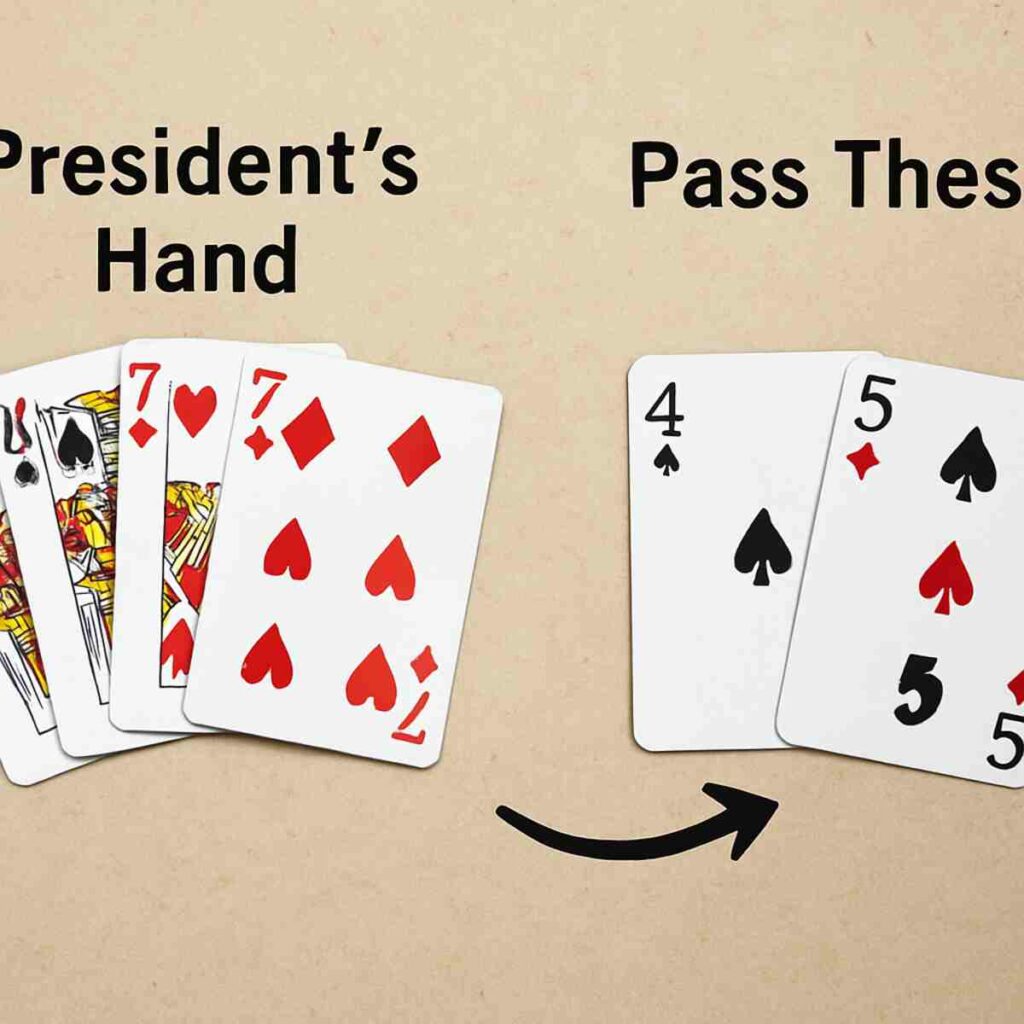
Congratulations, you’re the President! But with great power comes a critical decision: which two cards do you give to the Scum? This isn’t an act of charity; it’s your first move to solidify your power for the next round. Your goal is to weaken the Scum’s hand while making your own as strong as possible. This exchange sets the stage for the entire game, and a smart pass is a core part of any winning strategy.
The number one rule for this exchange is simple: pass your lowest, un-paired “junk” cards. Imagine your hand has a pair of Kings, a pair of 7s, a single 4, and a single 5. The correct move is to pass the 4 and 5. It can be tempting to get rid of a low pair like two 4s, but don’t do it! A pair, even a low one, can be played together. Those single, low cards, however, are liabilities that are difficult to shed and will only clog up your hand later on.
By following this strategy, you accomplish two things at once. First, you streamline your own hand, leaving you with powerful pairs, triples, and high cards that help you control the lead. Second, you intentionally sabotage the Scum’s hand by giving them the very cards they don’t want—useless singles that make it harder for them to form playable sets. You aren’t just giving away cards; you’re handing them an anchor. This is how a President stays President. But even a perfect pass can be undone by a surprise play from another opponent.
What is a ‘Bomb’ in Scum and When Should You Play It?
Just when you think a play is unbeatable—say, a trio of Kings hits the table—the game can be turned on its head. This is where a “bomb” comes in, your ultimate secret weapon. A bomb is a specific card combination so powerful it can be played out of turn to beat any other play, even a mighty 2. When a bomb is dropped, it instantly clears the pile and seizes the lead for the player who threw it down, completely hijacking the flow of the game.
The exact cards that make a bomb can differ depending on house rules, so it’s always smart to clarify before you play. However, you’ll almost always see these two versions:
- Four-of-a-kind: This is the universal bomb. Playing four 5s or four Jacks at once will clear any pile.
- A set of 2s: Some groups treat three or even just two 2s played together as a bomb.
Holding a bomb is powerful, but timing is everything. The biggest mistake you can make is using it too early. Resist the urge to drop your four 6s on a single Ace in the first few rounds. Instead, save your bomb for a true emergency. The perfect moment is when an opponent is about to go out, and you play your bomb to stop them in their tracks. Alternatively, use it to reclaim the lead late in the game when you have a bad hand and desperately need to be in control. Using it wisely is a key strategic move, and its value changes dramatically depending on how many players are at the table.
Scum Strategy for 3 Players vs. a Big Group: What Changes?
Have you ever noticed that a winning strategy in a small family game completely falls flat at a party with eight people? You’re not imagining it. The number of players at the table fundamentally changes what makes a good move, shifting the value of every card in your hand. Adjusting your approach based on group size is one of the easiest ways to improve your game.
In a smaller game of three or four players, raw power is king. With fewer opponents, your high cards like Kings and Aces are far more likely to win you the lead. It’s also easier to keep a rough mental tab on who has played what. The strategy in a three-player game often involves aggressively using your high singles or pairs to seize control and dictate the flow from start to finish.
Once you’re in a large group of six or more, however, the game becomes less about domination and more about survival. With so many hands in play, you should assume someone always has a higher card than you. The real danger isn’t failing to win the lead; it’s getting stuck with low, single cards. Therefore, in large groups, it is best to use any lead you get to shed your weakest single card. Playing a lone 5 might feel weak, but it forces the whole table to play singles and gets a useless card out of your hand.
Ultimately, the key is to shift your mindset. In small games, you play to win by overpowering your opponents. In large games, you play to not lose by carefully getting rid of your junk cards. This is also why a 2 becomes even more valuable in a big group—it’s often your only guaranteed way to reset a chaotic table and save yourself from becoming the Scum.
Is it Scum, President, or Asshole? Navigating Common House Rules
Walk into a game night, and you might hear the same game called Scum, President, or even the less-polite Asshole. Don’t worry—they are all names for the same chaotic fun. While the core goal of shedding cards to claim a title like President and avoid being the Scum is consistent, the specific rules can change dramatically from one living room to the next. These are known as “house rules,” and they can completely alter the game.
Just as your strategy should adapt, it’s crucial to know which rules you’re playing by. Before you play your first card with a new group, asking a few quick questions will save you from surprise moves later. The most common house rules often involve special powers or social customs.
Key questions to ask include:
- Are Jokers used? Sometimes they act as super-wilds or are the absolute highest single card.
- Can you play a “bomb” at any time? A bomb, usually a four-of-a-kind, often clears the pile, but some groups only allow it to be played on a single or a pair.
- Are there social rules? Does the Scum actually have to fetch drinks or shuffle the cards for the next round?
Knowing these potential twists isn’t about memorizing every possible rule; it’s about knowing what to ask. The number one rule for playing in a new setting is simply to ask, “What are your house rules?” This prevents arguments, shows you’re an engaged player, and ensures everyone starts on the same page.
Your New Scum Game Plan: 3 Simple Rules for Your Next Match
You no longer have to play Scum by just guessing which card to throw down. Where you once saw a random hand, you can now see a clear path forward. You’ve gone from hoping for the best to making the best of the cards you’re dealt.
Your new game plan focuses on one core goal: fight for the lead. Use your high cards strategically to gain control so you can dictate the flow of play.
Once you have that lead, your next move is to shed your junk by playing your lowest single card. But if you don’t have the lead and the play gets too high? Simply pass. Conserving your power cards is just as important as playing them.
This simple strategy is your key. Walk into your next game with this plan, and you’ll truly understand how to win at Scum—not by getting lucky, but by playing smart. You won’t just be avoiding the bottom; you’ll be fighting for the top.