


Looking for a new card game for your next get-together that doesn’t require a thirty-minute explanation? If you’re tired of the same old routine, allow us to introduce you to Nines. It’s the rare kind of game that is incredibly simple to learn, yet its clever blend of luck and strategy will have everyone at the table—from complete beginners to seasoned card sharks—laughing, groaning, and competing until the very last card is played. To learn more, check out UFAC4
At its heart, the Nines card game is all about predicting the future. Before each hand, you simply look at the cards you were dealt and make a bid on how many “tricks,” or individual rounds, you believe you can win. This simple twist is what makes it one of the most engaging card games for groups, as the challenge isn’t just winning, but winning the exact number of times you promised. Common experience shows this creates a perfect balance where a lucky beginner can easily beat a strategic veteran.
This guide will get you from shuffling the deck to dealing your first hand in under 10 minutes. We’ll cover the setup, the art of bidding, the rules of play, and how to tally the score to crown a winner. Ready to deal everyone in?
What You’ll Need to Start Playing Nines in 5 Minutes
Getting started with Nines is incredibly simple, and you likely have everything you need on hand already. You only need three things to get a game going:
- A standard 52-card deck. Just make sure to take out the jokers.
- 3 to 6 players. The game shines with 4 or 5 people, but any number in this range works perfectly.
- A pen and paper for keeping score. No special score sheet is necessary!
Because Nines is a game of predicting and outwitting your opponents, it can’t be played with only two people. The dynamic changes depending on your group size, which is part of what keeps it so interesting. Once you have your deck shuffled and your group assembled, you’re ready to learn the one simple goal that drives the entire game.
What’s the Goal? Understanding the Core Objective of Nines
Unlike games where you simply try to win as much as possible, the objective of Nines is all about accuracy. At the beginning of each hand, you will look at the nine cards you were dealt and make a bid—your prediction for how many rounds you think you can win.
Each of these rounds, where every player lays down one card from their hand, is called a trick. If four people are playing, a trick consists of four cards played, one from each person. The player who puts down the most powerful card wins that trick. After nine tricks have been played, the hand is over.
Your ultimate goal is to win the exact number of tricks that you bid. If you bid “three,” you score points only if you win precisely three tricks—not two, and not four. This dynamic of predicting your success and then trying to hit your target perfectly is what makes every hand of Nines a fun and suspenseful challenge.
How to Set Up and Deal for Your First Round of Nines
Getting the game started is straightforward. To pick the first dealer, have each player draw one card from the shuffled deck—whoever gets the highest card (Ace is high) deals first. For every hand after that, the job of dealing simply passes to the person on the previous dealer’s left, ensuring everyone gets a turn. This keeps the game fair and the action moving.
The dealer then shuffles the 52-card deck and begins distributing the cards one at a time, starting with the player to their left. This continues in a clockwise circle until every single player has a hand of exactly nine cards, which is where the game gets its name! Once you have your cards, keep them hidden from other players while you see what you’ve been dealt.
After everyone has their nine cards, the dealer places the remaining stack of cards face-down in the center of the table. This small pile isn’t just leftover; the very top card of this stack is about to determine the ‘trump suit’—a special suit with a game-changing advantage.
What Is a Trump Suit and How Is It Determined?
That small stack of leftover cards now plays its most important role. To begin the hand, the dealer simply flips over the top card of this stack, placing it face-up for all to see. The suit of this card—be it Hearts, Spades, Diamonds, or Clubs—becomes the trump suit for the entire round.
Think of the trump suit as having a “superpower” for the hand. Any card from this special suit is automatically more powerful than any card from the other three suits. This rule is at the heart of what makes Nines so exciting, as it can completely change the value of the cards in your hand. An otherwise weak-looking hand can become a powerhouse if it’s full of trump cards.
For example, imagine the dealer turns over a 4 of Spades, making Spades the trump suit. If one player leads a trick with the Ace of Hearts (a very high card), but you play the 2 of Spades (a very low trump card), you win the trick! Your “superpowered” Spade beats the high-ranking Heart. With the power suit determined, you’re ready for the game’s most crucial step.
How to Make Your Bid: Predicting Your Wins with Confidence
With the trump suit revealed, it’s time to make a prediction. Starting with the player to the left of the dealer, each person looks at their nine cards and declares out loud how many tricks they believe they can win. This declaration is called your bid. Your goal for the round is to win exactly the number of tricks you bid—no more, and no less.
To make a smart bid, take a moment to evaluate your hand. Look for high-ranking cards, like Aces and Kings, as these are likely trick-winners. More importantly, count how many trump cards you have. Since trump cards have that special “superpower,” each one is a strong candidate for winning a trick. A key part of your strategy for winning Nines is blending these factors. For instance, if you hold the Ace of trump and two other high cards, bidding “three” is a confident starting point.
What if your hand is full of low cards and has no trump? That can be a great hand, too. In this case, you can bid “Zero” (sometimes called “Nil”). This is a bold and strategic move where you predict you will win zero tricks. Playing a Nil hand is a fun, alternate challenge, as you’ll have to carefully play your cards to avoid winning any rounds. Succeeding at a Nil bid often earns a big point bonus.
Once everyone at the table has made their bid, the real fun begins. Here’s the twist: the total number of bids almost never adds up to nine. This guarantees that at least one person is destined to fail their bid, creating suspense from the very first card played. With all predictions locked in, it’s finally time to play.
How to Play a Trick: The Step-by-Step Flow of a Round
The player to the left of the dealer kicks things off by playing any single card from their hand. This first card is called the lead, and the suit of that card (Spades, Hearts, etc.) sets the rules for the rest of the players in that round, which is known as a trick.
Once the first card is on the table, the most important rule of play comes into effect: you must follow suit. This simply means that if the leader played a Spade, every other player must also play a Spade if they have one in their hand. You play your card in clockwise order around the table, creating a pile of cards in the center.
But what happens if you don’t have any cards of the suit that was led? This is where your strategy comes in. You have two choices. You can play any card from the trump suit, which will almost always win you the trick. Or, if you’re trying to avoid winning (perhaps for a “Zero” bid), you can discard an unwanted card from a different, non-trump suit. A discarded card cannot win the trick.
After all players have played one card, the trick is over and a winner is determined. The player who played the highest-ranking card of the original suit that was led wins the trick—unless a trump card was played. If any trump cards were played, the person who played the highest trump card wins. The winner collects the four cards, sets them aside, and then leads the next trick. This continues until all nine tricks have been won.
How Is Scoring Calculated in Nines? (It’s Simpler Than You Think)
After all nine tricks are played, everyone takes a moment to count up how many tricks they won. The crucial question is: did your total match your bid? If you nailed it, you get 10 points plus the number of tricks you bid. For example, if you bid “three” and won exactly three tricks, you score a satisfying 13 points (10 + 3) for the round.
One of the most important nines card game rules to remember is that scoring is all or nothing. There is no partial credit for being close! If you bid “three” but only won two tricks—or got a little too eager and won four—you score a big, fat zero for the hand. This simple rule is what makes the end of every round so tense and exciting as the final tricks are played.
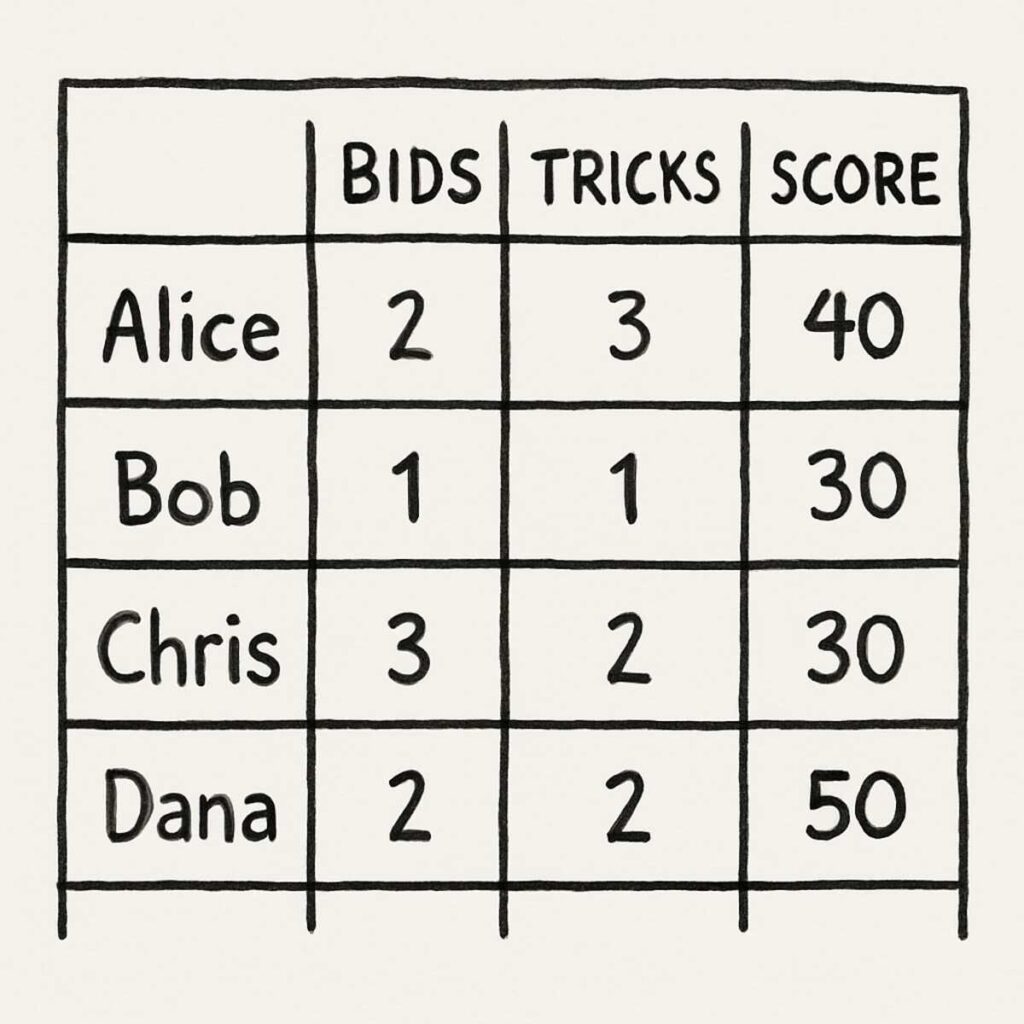
Keeping a running tally on paper is the easiest way to track the game. The most daring move, a successful “Nil” bid (bidding and winning zero tricks), often comes with a special bonus. Here’s a quick summary:
- Correct Bid: 10 points + your bid. (e.g., Bid 4, won 4 = 14 points)
- Incorrect Bid: 0 points. (e.g., Bid 4, won 3 or 5 = 0 points)
- Successful ‘Nil’ Bid: 15 points. (A common bonus for the tricky feat of winning nothing!)
(Image: A simple, hand-drawn style scoresheet showing a few players’ scores. One player, “Maria,” bid 3, took 3, and her score line shows “+13”. Another player, “Tom,” bid 2, took 3, and his score line shows “+0”.)
How Do You Win the Whole Game of Nines?
Most groups play to a target score, often 50 points. The game continues hand after hand, with scores being added up, until one player’s total meets or exceeds 50 at the conclusion of a round. That player is then declared the winner! Of course, you and your friends can always agree on a higher or lower target score if you want a longer or shorter game.
To keep things fair and interesting, the role of dealer shifts one spot to the left after every hand. This rotation ensures everyone gets a chance to deal and lead the bidding. The game continues in this fashion, round after round, until a champion is finally crowned.
Simple Strategies to Help You Win Your First Game
Beyond the basic rules, a little bit of cleverness is the key strategy for winning Nines. Unlike games of pure chance, your decisions matter here. Mastering a few simple tactics can turn a decent hand into a winning one and help you avoid the most common beginner blunders.
One of the most common mistakes to avoid in Nines is playing your powerful trump cards too early. Think of trumps as your secret weapons. Don’t waste one on a trick you could win with a regular high card from the suit that was led. Instead, save them for critical moments: either to steal a trick an opponent was about to win or to guarantee you hit your exact bid when the pressure is on.
But what about when you don’t want to win? If you bid “Zero” or “One,” high cards like Aces and Kings in non-trump suits become a major liability. Your goal should be to “dump” them. The best time to do this is when you cannot follow the suit that was led. By playing your unwanted high card on a trick you have no chance of winning, you safely get it out of your hand without accidentally taking a trick you didn’t bid for.
Finally, remember that your own hand is only half the story. Listen carefully to the bids made around the table. If the total number of bids is high (say, 11), you know the competition for each trick will be fierce. If an opponent bids “Four,” you can assume they are holding several high cards or trumps. Use this information to predict their plays and decide when it’s safe to play your own winners.
Ready for a Twist? 3 Fun Nines Card Game Variations
Once you’ve played a few rounds of Nines, you’ll see how its simple rules create surprisingly tense and fun moments. But the real beauty of a great card game is its flexibility. If you’re ready to shake things up, these popular variations can add a fresh layer of excitement.
- Two-Player Nines: Wondering can you play Nines with 2 players? Absolutely. Deal 10 cards to each player and create a 10-card “dummy hand” face down. After each trick, the winner takes the trick and the top card from the dummy hand, adding a fun element of luck.
- Jokers Wild: For a more powerful game, try using Jokers as wild cards. Add two Jokers to the deck; they automatically become the highest-ranking trump cards, beating even the Ace. If a Joker is led, other players can play any card they wish.
- Progressive Nines: In this challenging version, the number of cards dealt changes each round. Start with nine cards, then deal eight, then seven, and so on down to one card. After the one-card round, you work your way back up to nine!
You’re Ready to Play
Now you have everything you need to deal a hand and lead your friends through their first game. Your first step is simple: play one hand and don’t worry about perfect strategy. Just focus on following suit and getting a feel for the flow of a trick.
Once you’re comfortable, start paying closer attention to your bidding—that’s where the real fun begins. The core challenge of Nines is simple: can you do exactly what you said you would? The game’s magic isn’t in flawless play, but in the delightful chaos of everyone trying to hit their mark. You’re ready to create those memorable moments of groans and glory that happen when the last card is played.