


Looking for a fun, easy-to-learn card game that’s perfect for your next family night or get-together? If you’re tired of complex board game setups, Joker Rummy is a classic for a reason. It’s a simple twist on the traditional card game that adds a dash of unpredictability and a lot of fun. This guide covers the Joker Rummy rules for beginners, designed to get you from zero to playing your first game in under 10 minutes. To learn more, check out UFAZEED
At its heart, the Joker Rummy card game has one simple objective: be the first player to organize all the cards in your hand into specific groups. You accomplish this by collecting “melds,” which are either sets of the same rank (like three Kings) or sequences of the same suit (like the 4, 5, and 6 of Hearts). Getting all your cards into these neat little piles before anyone else is how you win.
The best part? You probably have everything required for a game right now. Before you deal the first hand, just make sure you have these components ready:
- 2 standard 52-card decks
- 2 printed Jokers per deck (4 total)
- 2 to 6 players
- A piece of paper for scoring
With your cards and friends assembled, you’re ready to play. From dealing the cards to using those game-changing wild cards, here’s exactly how to play rummy with jokers and claim victory.
The Building Blocks of a Winning Hand: How to Form Sets and Sequences
The main goal in Joker Rummy is to organize all the cards in your hand into valid groups called melds. Getting rid of your cards by forming these melds is how you win the game. There are two fundamental types of melds you can create.
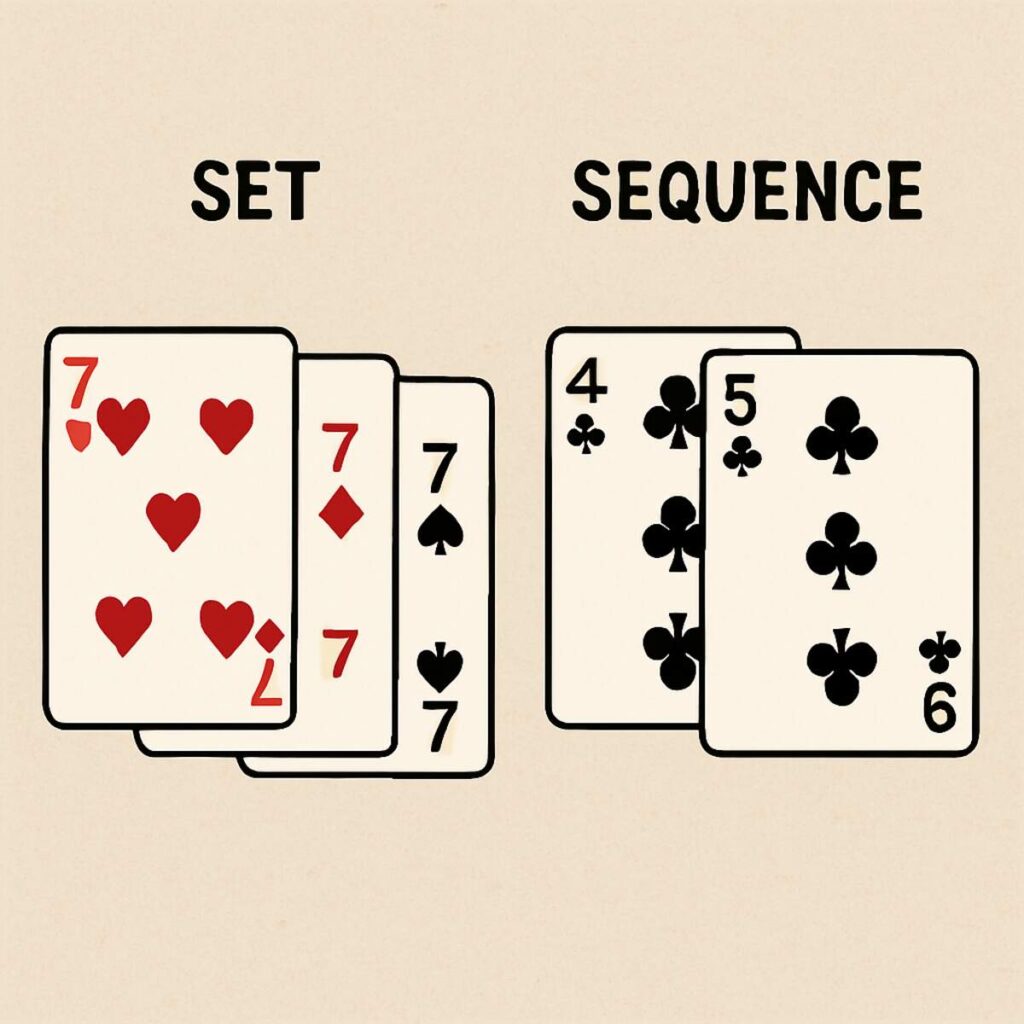
One type of meld is called a Set. This is a group of three or four cards that share the same rank (like all 8s or all Kings) but have different suits. For example, a 7❤️, 7♦️, 7♠️ is a valid set. You couldn’t use two 7s of Hearts in the same set because the suits must be unique.
Your other option is to form a Sequence, which is sometimes called a run. A sequence is a group of three or more cards of the same suit in consecutive order. A hand like 4♣️, 5♣️, 6♣️ is a perfect example of a sequence. The Ace can be used as either the low card (A-2-3) or the high card (Q-K-A), but usually not both at once.
Finally, a Pure Sequence is simply a sequence made without the help of a wild card. Most Rummy rules state that you must have at least one pure sequence in your hand to declare your hand and win the round. But what happens when you’re just one card away from a great meld? That’s where the Joker comes in, acting as a powerful wild card that can turn a good hand into a great one.
The Joker’s Superpower: How to Use a Wild Card to Your Advantage
In Joker Rummy, the term “Joker” refers to two different kinds of wild cards. The first is the one you already know: the Printed Joker that comes with the deck, often featuring a jester. The second type is a Wild Card Joker, also called a “cut joker,” which changes every round. Before the cards are dealt, one card is drawn from the deck and placed face-up. This card’s rank determines the wild card for that entire round. For instance, if a 7 of Hearts is drawn, all 7s in the deck (7❤️, 7♦️, 7♣️, 7♠️) become additional Jokers, alongside the printed ones.
A Joker’s primary job is to act as a substitute, filling in the gaps of an incomplete set or sequence. It can become whatever card you need most. For example, if you are holding a 9♦️ and a J♦️, you are just missing the 10♦️ to complete your sequence. If you have a Joker, you can slip it in between them to create a valid meld: 9♦️, Joker, J♦️. This superpower makes forming melds much easier and adds a layer of exciting unpredictability to the game.
However, using a Joker comes with one important rule: you must declare what card it represents. When you lay down a meld using a Joker, you have to state its assumed suit and rank. If you used a Joker to complete a set of Kings (K♠️, K♣️, Joker), you would announce, “This Joker is the King of Hearts.” This ensures all players know what the meld represents. With these powerful Jokers in your toolkit, you’re ready to see how a game officially begins.
Setting Up the Game: From Shuffling the Deck to Starting the Piles
To get things started, one player acts as the dealer. After a thorough shuffle of both decks and all printed Jokers, the dealer passes out 13 cards one by one to each player, moving clockwise. Managing these 13 cards is your central challenge. Players can look at their own cards but should keep them hidden from opponents.
Whatever cards are left over from the deal are placed face-down in the center of the table. This stack is called the Stock Pile. Think of it as the game’s main drawing pool, holding all the unknown cards that players will draw from throughout the game.
The dealer then takes the top card from the newly formed Stock Pile and places it face-up right next to it. The rank of this card (for example, a 4, a 9, or a Queen) becomes the “Wild Card Joker” for this round. This face-up card has another job: it becomes the very first card of the Discard Pile.
At this point, your playing area is set. You have the face-down Stock Pile for drawing and the face-up Discard Pile, which will grow as players take their turns. The game is officially set up, and the action begins with the player to the dealer’s left.
The Rhythm of the Game: How to Play Your Turn Step-by-Step
The action starts with the player to the dealer’s left and continues clockwise, with each person following the same three steps. Your turn always begins with one choice: drawing a card. You can either take the unknown top card from the face-down Stock Pile or pick up the top card from the face-up Discard Pile. Taking from the discard is a calculated risk—everyone sees what you took, but it might be the exact card you need.
After drawing a card, you get the chance to “meld” by laying down any complete sets or sequences from your hand. You place these card groupings face-up on the table in front of you. This is the main way you get rid of cards, so it’s the key to winning. If you have a valid meld, now is the time to show it. However, this step is completely optional on each turn.
To finish your turn, you must perform one final, mandatory action: discard. You’ll select any single card from your hand that you don’t need and place it face-up on top of the Discard Pile. This action officially ends your turn and signals to the next player that it’s their go. Think carefully about what you discard, as the next player might be able to use it!
Every player’s turn follows this exact three-part sequence: 1. Draw, 2. Meld (optional), 3. Discard. You and your opponents will repeat this process, trying to be the first one to arrange all your cards into melds, which builds toward the moment a player can finally win the round.
How to Make a Valid Declaration and Win the Round
The ultimate goal in Joker Rummy is to be the first player to group all 13 of your cards into valid melds. When you finally achieve this, you make a “declaration” to win the round. To do this, you draw a card on your turn, arrange your hand, and then place all your cards, including your final discard, in their proper groups on the table. However, your hand must meet three specific conditions to be considered a valid win.
For your declaration to count, your hand must satisfy all the requirements on this checklist:
Valid Declaration Checklist:
- All 13 cards are grouped into valid Sets or Sequences.
- You have a minimum of two sequences in your hand.
- At least one of those sequences is “pure” (made completely without a Joker).
The pure sequence rule is the most crucial. A pure sequence shows you’ve built a meld the old-fashioned way, like a 5♦️, 6♦️, 7♦️. This requirement prevents a player from winning purely on the luck of drawing multiple Jokers. Once you’ve met all three conditions, you declare your win by melding everything and placing your final, 14th card on the discard pile. This move officially ends the round and moves the game into scoring.
The High-Stakes Question: Can You Discard a Joker?
Sooner or later, every new player faces a dilemma: you have a Joker in your hand, but it doesn’t fit into any of your plans. This leads to a common strategic question: can you actually discard a Joker? The simple answer is yes, you can. During your turn, you are legally allowed to discard a Joker just like any other card.
However, choosing to do so is one of the riskiest moves you can make. When you discard a Joker, you’re essentially handing the next player a “golden ticket” that can complete any set or sequence they need. An opponent who picks up your discarded Joker might use it to immediately make a declaration and win the round. For this reason, most experienced players will hold onto a Joker at all costs.
With that said, there is one key situation where discarding a Joker is the correct move. If you draw a card that allows you to meld all 13 of your cards, your 14th card must be discarded to win. If that leftover card happens to be a Joker, you have no choice but to discard it to declare your victory. While giving away a Joker is dangerous, using it to seal your own win is the ultimate power play.
Keeping Score: How to Calculate Points with Jokers in Play
Once a player declares and wins a round, they get the best score possible: zero points. For everyone else, the game shifts to calculating the value of the cards left in their hands. Think of these as penalty points—your goal across several rounds is to keep your total score as low as possible.
The value of each card is easy to remember, but the penalty for holding a Joker is what really changes the game. Here’s a standard breakdown according to Joker Rummy rules:
- Printed & Wild Jokers: 50 points
- Aces, Kings, Queens, Jacks: 10 points
- Number Cards (2-10): Face value (e.g., a 7 is worth 7 points)
As you can see, getting caught with a single Joker is more punishing than holding four face cards combined. If your hand has a Queen (10 points), a 4 (4 points), and a Joker (50 points), you’d rack up a painful 64 points for that round alone. Understanding these penalties is key to building a winning mindset and avoiding costly points.
3 Simple Strategies to Win Your First Games
Knowing the rules gets you into the game, but making smart decisions will help you win it. Focusing on these simple strategies will help you play with more confidence and avoid common beginner mistakes.
Your first priority on every hand should be to form at least one solid meld, especially a sequence (like 5♦️, 6♦️, 7♦️). Until you have a group of cards coming together, your hand is just a random collection. Creating that initial meld gives your hand direction and makes it easier to decide which cards to keep and which to discard.
Beyond your own hand, start thinking about risk. Since cards like Kings, Queens, and especially Jokers carry heavy point penalties, they become dangerous to hold onto for too long. If you have a high-value card that isn’t part of a potential meld after a few turns, a wise move is often to discard it. You’re reducing the damage if another player suddenly declares.
Finally, the discard pile tells a story. Pay attention to what the player before you throws away. If they discard the 8♠️, it’s a safe bet they don’t need other 8s or cards from the spade suit. This simple observation gives you valuable information, helping you decide what to discard without accidentally handing your opponent the exact card they need. These simple shifts in focus are common in many Rummy-style games, which often leads players to wonder how Joker Rummy stacks up against other popular versions.
Joker Rummy vs. Indian Rummy: What’s the Main Difference?
You might hear Joker Rummy mentioned alongside another popular version: Indian Rummy. In many ways, they are almost the same game. Both are often called “13-card Rummy” and share the same goal of forming sets and sequences. This overlap makes the skills you’ve just learned easily transferable between them.
The main point of distinction in the Joker Rummy vs Indian Rummy debate is how the wild card is determined. In the game we’ve covered, the printed Jokers are always wild. However, many traditional 13 card rummy joker rules add a twist: a random card is drawn from the deck after the deal. All cards of that rank (for example, all 4s) then become additional wild cards for that specific hand.
Ultimately, this is just a minor rule change. The core gameplay of drawing, melding, and discarding remains the same no matter which card is wild. By understanding Joker Rummy, you’re already prepared for most versions you’ll encounter.
Ready, Set, Rummy! Your 5-Minute Game Night Checklist
You now have the complete blueprint to deal the cards, play your turn, and confidently declare a winning hand. The concepts of sets, sequences, and wild cards are simple tools you are ready to use. Keep this guide handy as a quick reference for your first round.
- Quick-Start Checklist:
- Setup: Use 2 decks + 4 Jokers. Deal 13 cards each. Flip one card for the discard pile; the rest are the stock pile. Determine the wild card joker.
- Your Goal: Be the first to meld all 13 cards into Sets and Sequences.
- The Golden Rule: You MUST have at least one Pure Sequence (no Joker) to win.
- Your Turn: Draw one card (from stock or discard), optionally meld, and discard one card to end.
- Win: Once all cards are melded correctly, ‘Declare’ your hand and get zero points!
The best way to master Joker Rummy is to put your knowledge into motion. Grab a couple of decks, gather your friends or family, and deal your first hand. The fun begins now.