


Ready to play what many call the world’s fastest game? Blink is all about quick eyes and even quicker hands, a game where victory is measured in seconds, not minutes. The secret to its speed is a simple but game-changing twist: there are no turns. All players race to play matching cards at the same time, creating a fun, chaotic scramble. The objective is just as straightforward—be the first person to play every card from your personal pile, and you win. To learn more, check out okervip
This guide gets straight to the point. Forget the confusing rulebook; in the next three minutes, you will go from shuffling the deck to confidently playing your first round.
How to Set Up a Blink Game: From Box to Play in Under 60 Seconds
Getting a game of Blink started is just as fast as playing it. First, shuffle the whole deck and deal the cards out evenly between two players. For a standard game, you will each have 30 cards. Place your stack of cards face-down in front of you without looking at them. This is your personal Draw Pile—the stack you need to get rid of to win the game.
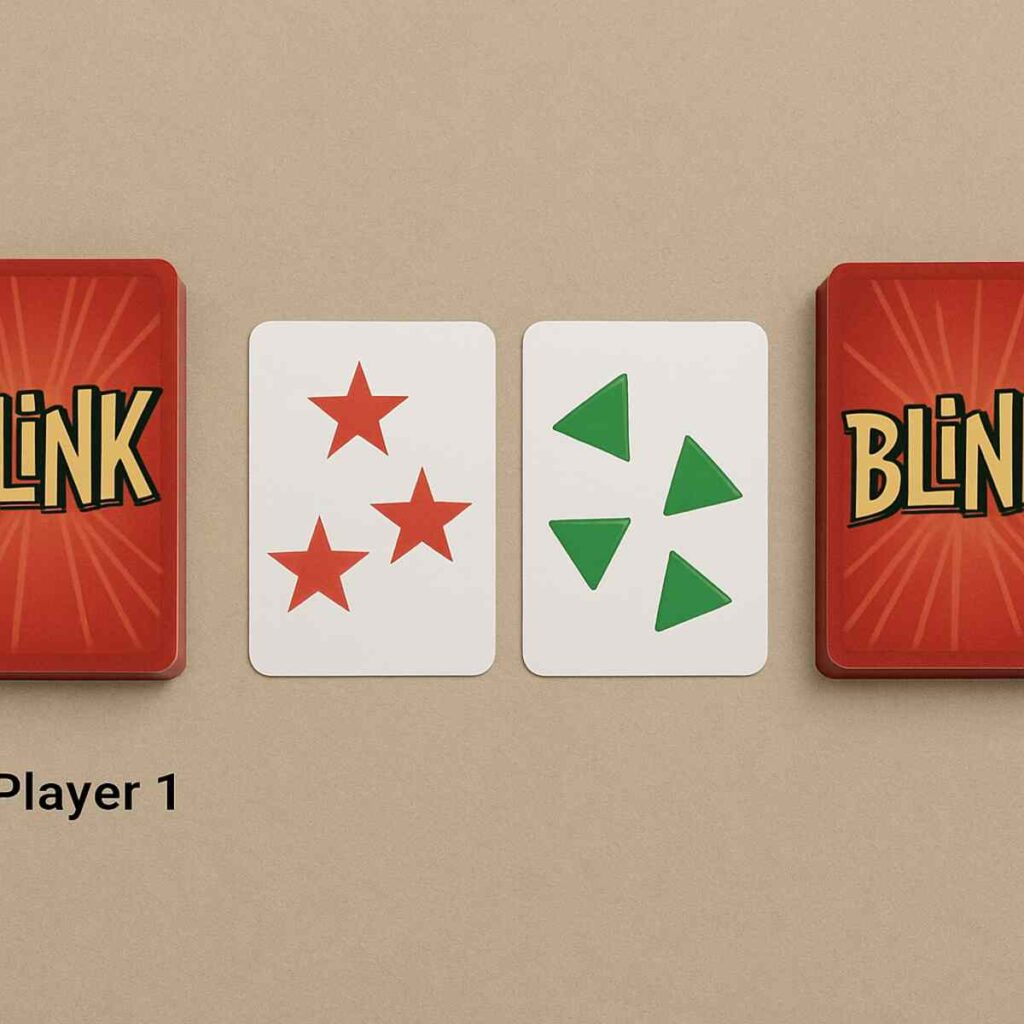
With the piles dealt, you’re ready to create the play area. At the exact same time, both players must flip over the top card of their Draw Pile and place it face-up in the center of the table, side-by-side. These two face-up cards create the two starting Discard Piles, which are the active piles you’ll be playing your cards onto.
Your game should now be set up and look just like the photo below. You’ll have two personal Draw Piles (one for each player) and two shared Discard Piles in the middle. The entire game revolves around matching the cards in your hand to the cards on top of those Discard Piles.
The 3 Ways to Match a Card in Blink: Color, Shape, or Count
Making a match in Blink is simple because you always have options. To play a card from your hand onto one of the two Discard Piles, it only needs to match the top card in one of three ways. You don’t need to match all three attributes; just one is enough to make a legal play.
A match is based on a card’s:
- COLOR (yellow, red, green, blue, etc.)
- SHAPE (stars, moons, triangles, etc.)
- COUNT (the number of shapes on the card, from one to five)
For example, imagine the top card on a Discard Pile shows three yellow stars. You could play any card with yellow on it, any card that has stars, or any card that has exactly three symbols on it (like “three green moons”). Since many cards in your hand will have at least one of these traits, you can often play a card almost immediately.
Knowing your options is the key to speed. Before you even begin, glance at the cards in your hand and see how they might connect. But just knowing what to play is only half the battle; the real test of reflexes comes from the game’s core rule.
The Most Important Rule: Why Blink Has No Turns and How to Handle a Tie
The single rule that makes Blink the world’s fastest game is this: there are no turns. As soon as the two starting cards are flipped to create the Discard Piles, the game becomes a complete free-for-all. All players play their matching cards onto either pile at the same time, as quickly as they can spot a match. Think of it as a race to empty your hand and Draw Pile first.
This chaotic speed naturally leads to one very common question: what happens if two people play a card at the exact same time? The resolution is beautifully simple. The first card to physically land on the pile is the one that stays. The player whose card arrived a split-second late just takes their card back into their hand. There’s no penalty; you just look for the next chance to play that card, which will probably appear in another second!
This constant race is the heart of the game. With cards changing the piles so rapidly, you’ll need to think fast to keep up. Playing cards this quickly also means you’ll often run out of options in your hand, which leads to the next step.
How to Manage Your Hand and Draw New Cards
As you play cards at lightning speed, you’ll find your hand getting smaller. To keep the game fair and fast, Blink has a strict rule: you can only hold a maximum of three cards in your hand at any time. You’ll start the game with three, and your goal is to always get back to that number whenever you dip below it.
The moment you play a card and your hand drops to two, one, or even zero cards, you can immediately draw more. You don’t have to wait or ask for permission. Simply take cards from your personal Draw Pile—the face-down stack in front of you—until your hand is full with three cards again.
Refilling your hand this way is the only method for getting new cards and is a key part of the game. Since the goal is to get rid of your Draw Pile, every card you draw is one step closer to victory. But what happens if you’re holding three cards and none of them match the piles? That’s when a special rule comes into play.
What Happens if No One Can Play in Blink?
Every so often, the fast-paced action of Blink will grind to a halt. You’ll be staring at your three cards, your opponent will be doing the same, and you’ll both realize that nobody has a legal move. This stalemate is a normal part of the game. When everyone agrees that play is stuck, one player needs to take action to get things moving again.
To break the stall, one player can volunteer to “sacrifice” a card. The volunteer takes the top card from their own Draw Pile—without looking at it—and places it face-up on top of either one of the two center Discard Piles.
This single move instantly changes the game. The new card provides fresh opportunities for everyone to start matching by color, shape, or count again. As soon as that card hits the pile, the race is back on! All players can immediately resume playing cards from their hands as fast as they can.
Deciding to be the one to break the stalemate comes with a small cost. Since the sacrificed card comes from your personal Draw Pile, you are essentially putting a card you need to get rid of back into play. It helps everyone, but it doesn’t directly shrink the pile you ultimately need to empty to win.
How Do You Win in Blink? It’s All About the Draw Pile
The objective of Blink is to be the first player to get rid of all the cards from your personal Draw Pile. This is the single most important rule to remember about winning. While you’ll be playing cards from your hand of three, your hand will constantly be refilled from your Draw Pile. The game is won when your Draw Pile is gone and you’ve played your final cards.
As you play, you’ll eventually deplete your Draw Pile by refilling your hand. Once that pile is empty, you are on the home stretch! The goal now is to simply play the last one, two, or three cards remaining in your hand. You don’t draw any more cards for the rest of the game. Just focus on finding a match for what’s left in your hand.
The game ends the instant you legally place your very last card onto one of the center piles. The second it leaves your hand, you’ve won! It’s common to shout “Blink!” or simply announce that you’re out. There’s no need to wait for the other player to finish. The race is over.
The Blink Game Tie-Breaker: What if Everyone Wins at Once?
In the incredibly rare event that two players play their very last card at the exact same moment, it can feel like a confusing photo finish. The official Blink game tie-breaker rule suggests playing a “best of three” series. Think of the tied game as Round 1. You then shuffle up and play again. The first person to win two total games is the overall winner. This method is great for competitive players who want a definitive outcome.
If a full series sounds too formal for a quick, casual game, most players use a much faster house rule: sudden death. Simply agree that the tied game was a draw, reshuffle all the cards, and play one more winner-take-all round. It keeps the energy high and gets you right back into the action.
Blink Rules at a Glance: Your 30-Second Refresher Guide
Need a quick reminder? Whether you’re teaching a new player or just settling a mid-game question, this cheat sheet has you covered.
- Goal: Be the first player to get rid of all cards from your personal Draw Pile.
- Setup: Deal cards into face-down Draw Piles for each player. Flip two cards from the tops of those piles into the center to start the Discard Piles.
- Play: Always hold three cards. Play one if it matches the COLOR, SHAPE, or COUNT on top of either Discard Pile.
- Speed Rule: There are NO TURNS! Everyone plays as fast as they can. If two cards land at the same time, the first one to touch the pile stays.
- Drawing: If your hand size drops below three, immediately draw from your Draw Pile until you have three cards again.
- Stuck?: If play stalls, any player can place the top card of their Draw Pile onto a Discard Pile to restart the action.
Once you’ve mastered these basics, you can start thinking about how to play smarter, not just faster.
Your First Blink Strategy: Why You Must Watch Both Piles to Win
A common trap in Blink is locking your eyes onto just one of the two discard piles. This “tunnel vision” feels focused, but it’s the single biggest reason players get stuck with a hand full of cards. By focusing on only one pile, you are literally ignoring half of your opportunities to play.
The key to playing Blink effectively is to break this habit. Your eyes should constantly dart back and forth between the top card of Pile A and the top card of Pile B. Every time a new card lands, your brain should process both options at once. By actively looking at both piles, you instantly double your chances of finding a match and getting ahead of your opponent.
Developing this habit is your first step toward “Blink awareness.” You’ll begin to see the whole board, not just a fraction of it. You’ll quickly realize that winning isn’t just about having fast hands—it’s about having fast eyes. As you master watching both piles, you’ll start to spot more advanced opportunities.
The ‘Color Flush’ Strategy: How to Discard Multiple Cards in a Row
Once you get comfortable scanning both piles, you’ll start to see more than just single matches. The next level of winning in Blink is learning to play multiple cards in a single, lightning-fast burst. This powerful move, the “Color Flush,” is your best tool for emptying your hand before your opponent even knows what happened.
Imagine you’re holding a blue star, a blue moon, and a yellow triangle. As soon as a blue card appears on either discard pile, you can slam down your blue star. Because the new top card is now your blue star, you can immediately play your blue moon right on top of it. This sequence lets you discard two-thirds of your hand in the time it normally takes to play just one card.
This tactic is a core strategy because our brains recognize color faster than we can count symbols or identify shapes. While your opponent is still trying to figure out if they have a card with four of something, you’ve already matched two yellow cards in a row. To take advantage of this, start glancing at your hand to see if you have two or three cards of the same color, getting them ready for a rapid-fire play.
Mastering the Color Flush changes the game from a simple matching exercise into a race of strategic bursts. It’s how you gain a massive lead and put intense pressure on your opponent.
Can More Than 2 People Play Blink? Your Guide to 3 and 4-Player Games
While Blink is famous as a two-player duel, the official rules include an exciting variation for three or even four players. Adding more people turns the speed and friendly chaos up to a whole new level, making it a fantastic way to include the whole group.
Getting started is just as easy. Simply shuffle the entire deck and deal the cards out as evenly as possible to each player. Everyone keeps their cards in a personal face-down Draw Pile, just like in the standard game.
The biggest change is how you play. Instead of creating two discard piles, you only flip over one card from the remaining deck to start a single, shared Discard Pile. Now, all players must race to play their matching cards on this one central pile.
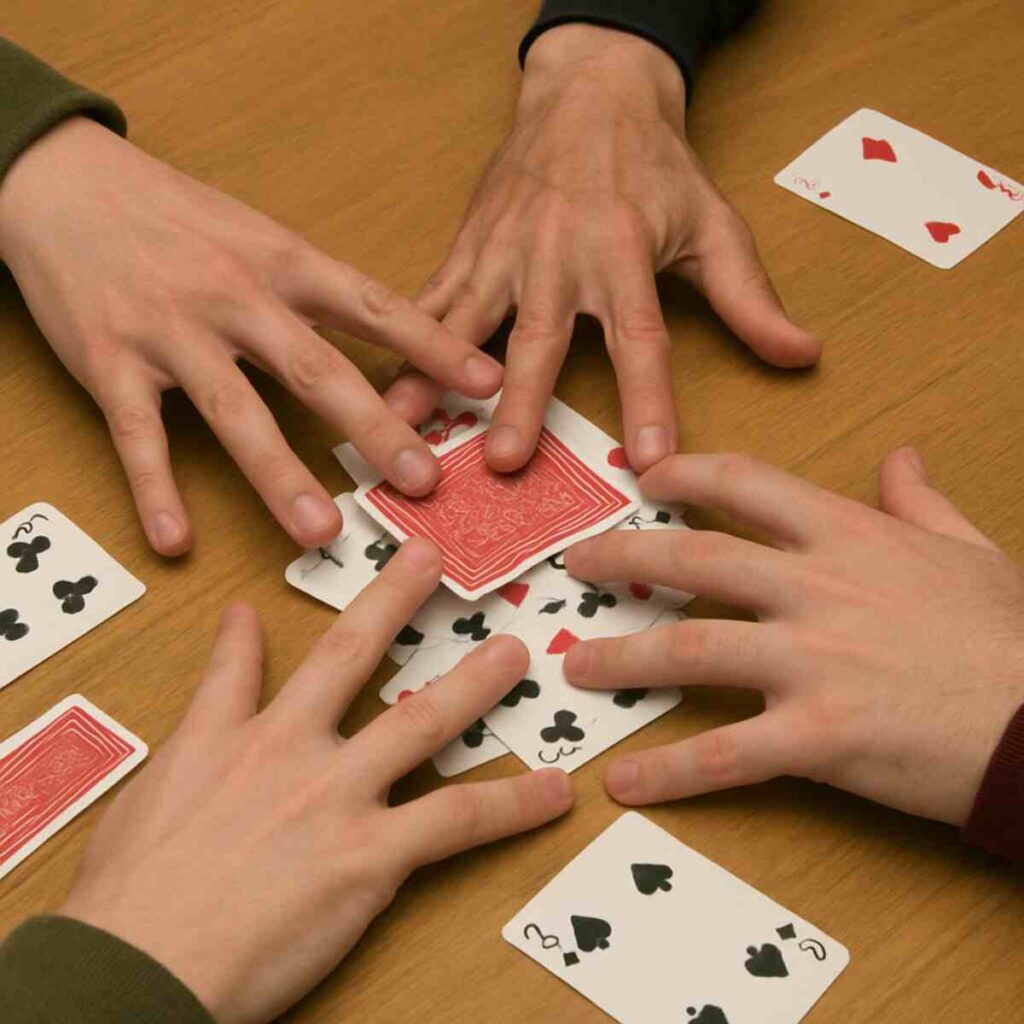
This shift to a single pile completely transforms the game’s dynamic. With three or four hands all trying to slap down a card at once, every single play becomes a mad dash. This variation concentrates all the focus and action into one spot, making for a wild, lightning-fast experience.
3 Fun Blink Game Variations and House Rules to Spice Up Game Night
Love the speed of Blink but looking to mix things up? Trying out a few simple variations and house rules is the best way to keep the game feeling fresh and exciting. The beauty of a simple game is that it’s easy to customize.
- Full Deck Sprint: No draw piles! Deal the entire deck out among the players. The first person to empty their hand wins. It’s a pure, frantic race to the finish from the very first card.
- Silent Blink: The name says it all. No talking, shouting, or gloating is allowed—only the sound of cards hitting the table. This version adds a layer of intense, quiet focus to the chaos.
- Handicap Rule: To even the odds, the more experienced player must match by TWO criteria (e.g., Color AND Shape), while the beginner plays normally with just one match required.
The handicap rule, in particular, is a game-changer for families or groups with mixed skill levels. It allows a seasoned player and a total newcomer to have a genuinely competitive and fun match. The expert gets a brain-bending challenge, and the beginner has a fair shot at winning.
Blink vs. Uno: Which Fast-Paced Game Is Right for You?
When looking for a quick, colorful card game, the Blink vs. Uno debate often comes up. While both are easy to learn, they offer completely different experiences. The core difference is simple: Blink is a frantic race where everyone plays at once, while Uno is a turn-based game for a larger group that’s all about waiting for your moment.
A round of Blink is pure, chaotic speed, testing your reflexes and how fast your eyes can send signals to your hands. There’s almost no time for deep strategy; you just find a match and get your card down first. Games are often over in a minute or two, making it perfect for quick bursts of head-to-head competition.
Uno, on the other hand, is more of a social and strategic marathon. You wait for your turn, think about which card to save, and anticipate what others might play. The excitement in Uno comes from the drama of a well-timed “Skip” or a devastating “Draw Four” card. It’s a game of patience and playful sabotage.
So, which should you choose? Pick Blink for a lightning-fast duel that tests your reflexes. Grab Uno for a classic, turn-based party game that allows for more players and strategic moments.
Is Blink a Good Game for Kids? A Parent’s Guide to Its Benefits
Beyond the fast-paced fun, is Blink a good game for kids? The answer is a resounding yes. It’s one of those rare activities that feels like pure play but acts as a powerful workout for a child’s developing mind.
At its core, Blink is a rapid-fire exercise in visual perception. Players are constantly scanning for shape, color, and count, training their brains to recognize patterns and process information at incredible speeds. This skill, being able to see a match and react quickly, is a fantastic way to sharpen mental reflexes without it ever feeling like homework.
While the box suggests ages 7 and up, the real magic lies in its quick rounds. A whole game is often over in less than two minutes, which provides the perfect, low-stakes environment for teaching good sportsmanship. A loss isn’t frustrating when you can just say, “Okay, best two out of three!” and immediately start again. It teaches resilience without the tears.
Blink is more than just a speedy distraction. It’s a tool for sharpening key mental skills wrapped in a genuinely fun package, making it a standout choice for kids.
Love Blink? Try These 3 Other Lightning-Fast Card Games
If the frantic energy of Blink is what your family loves, the world of fast card games has several other gems that capture that same chaotic fun. It’s a special kind of game where everyone plays at once, turning a simple matching concept into a thrilling race.
For a very similar feeling, look no further than Spot It!. Like Blink, it’s all about speed and visual recognition, but instead of matching in three ways, you’re trying to find the single matching symbol between any two round cards.
Other games like Blink are Dutch Blitz and its European cousin, Ligretto. These games take the race to a new level. All players simultaneously try to play cards from their personal “Blitz” pile into shared, central piles, creating a wonderfully hectic and competitive experience that will feel instantly familiar to any Blink champion.
Each of these games channels the Blink spirit of quick thinking and even quicker hands. They prove that sometimes the most memorable game nights are the ones that are over in a flash, leaving everyone laughing and ready for the next round.
Final Tips for Your First Game
You now understand the rules and strategies that make Blink a lightning-fast favorite. The key to victory isn’t about deep thinking; it’s a fun, frantic race to empty your draw pile first. Remember to scan both discard piles to double your opportunities and look for ‘Color Flush’ chances to play multiple cards in a row.
Trust your eyes—if you see a match by color, count, or shape, play that card! Now, shuffle the deck, flip the first two cards, and let the high-speed matching commence. Enjoy the race!