


The secret to winning the For Sale card game isn’t just buying the best properties—it’s knowing exactly when to get the worst ones for practically free. While it feels great to bid on a skyscraper, the game doesn’t reward you for owning the fanciest portfolio. In fact, there is only one goal: end the game with the most money. Everything you do, from bidding aggressively to folding early, must serve that single purpose. To learn more, check out Soju88 Daftar
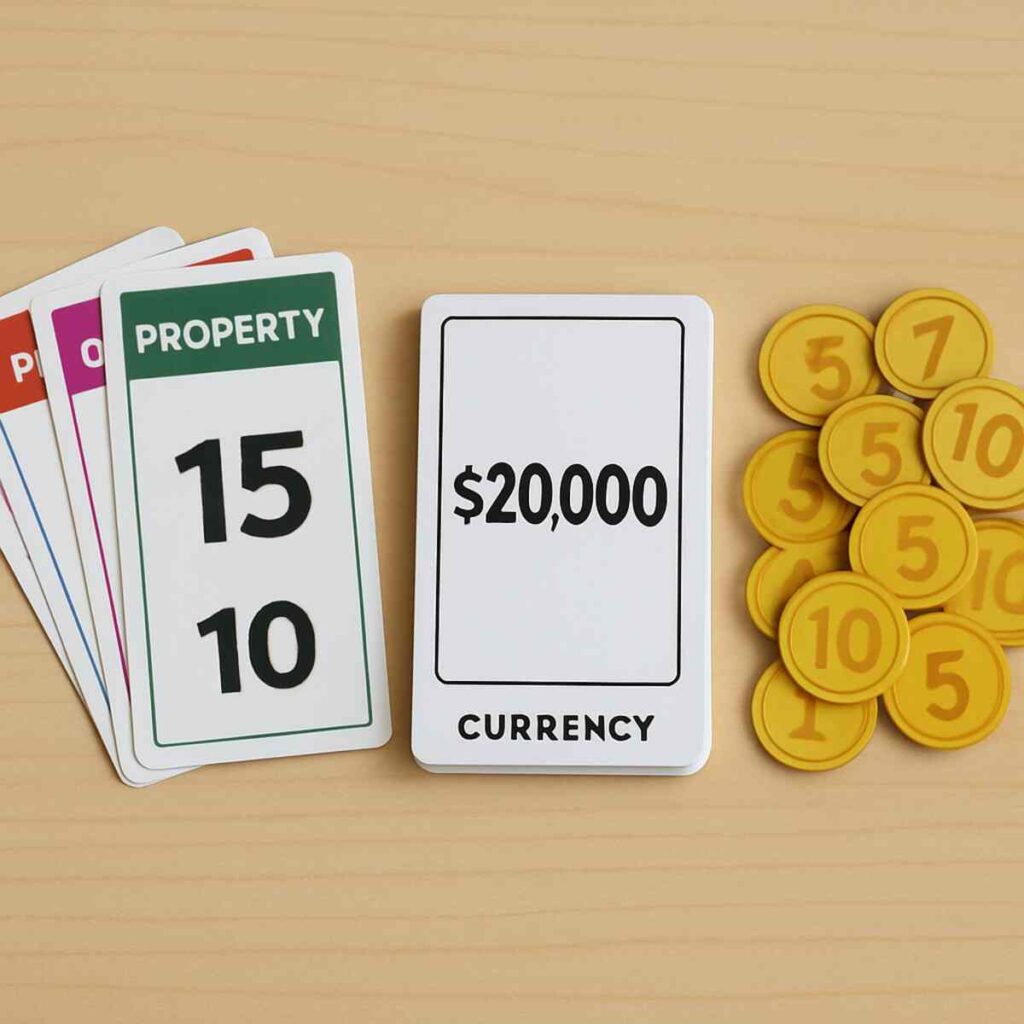
Your entire strategy revolves around two distinct types of cards. First are the Property Cards, which are your assets. These cards are numbered 1 to 30, representing everything from a lowly cardboard box to a gleaming space station. In the game’s first half, you buy these. Then come the Currency Cards, which represent your profit. These are the paychecks you’ll earn in the game’s second half by selling the properties you just acquired.
So, how do you buy those first buildings? At the start of the game, every player gets an equal pile of money tokens. This is your entire budget for the buying phase, and in practice, learning how to spend it wisely is the first skill every new player masters. The core loop is simple: use your starting cash to acquire Property Cards, then flip those properties to collect the most valuable Currency Cards. The player who manages this buy-low, sell-high dance most effectively wins.
[Image: A clean, well-lit photo showing the three main components of the game side-by-side: a small fanned-out selection of Property Cards (showing numbers like 1, 15, 30), a stack of Currency Cards (showing values like $2,000, $15,000), and the pile of money coins.]
How the Game Works: A Quick Look at the ‘Buy’ and ‘Sell’ Phases
The beauty of For Sale is that it’s neatly split into two simple halves, making it incredibly easy to learn how to play. First, you enter the Buy Phase, where everyone acts as a real estate investor. Your only goal here is to use your starting cash to bid on and acquire a portfolio of Property Cards—everything from a lowly cardboard box to a glorious skyscraper. You’re not trying to earn money yet; you’re simply trying to get the best buildings you can without going broke.
Once all the properties have been bought, the game completely shifts into the Sell Phase. In this second half, you take all those properties you just fought for and try to flip them for the biggest profit. Everyone simultaneously chooses a building from their hand to sell, hoping to snag the highest-value check on the table. This is where the game is won or lost, as the player who masterfully bought low and sold high will walk away the richest.
The Art of the Bid: How to Buy Properties Without Going Broke
With your starting money in hand, you’re ready to enter the property market. Each round of the Buy Phase begins by flipping over as many Property Cards as there are players. These cards, ranging from a humble Cardboard Box ‘1’ to a magnificent Skyscraper ’30’, are laid out for all to see. The player to the left of the dealer kicks things off by looking at the available properties and placing the first bid.
Now, the auction moves around the table in a circle. When it’s your turn, you face a simple but critical choice: you can either bid more money than the person before you, or you can “pass.” Making a higher bid keeps you in the running for the most valuable property available, but it also drives up the price. Passing, on the other hand, means you are dropping out of the auction for this particular round. Learning when to push your luck and when to fold is the key to a good buying strategy.
This process continues, with players either raising the bid or strategically passing, until only one person is left in the auction. That last bidder is the winner! They must pay the full amount of their final bid to the bank and, in return, they claim the single best Property Card on the table. It feels great to win a prime piece of real estate, but be careful—paying too much can leave you poor for later rounds.
So what happens to everyone else who passed? This is where the game gets incredibly clever. Passing doesn’t mean you walk away empty-handed; it’s actually how you acquire the other, less valuable properties for a major discount. In fact, knowing how and when to pass is just as important as knowing when to bid.
What Happens When You ‘Pass’? The Simple Rule That Wins Games
Passing isn’t a sign of defeat; it’s one of the smartest moves you can make. When you decide to pass, you drop out of the bidding for that round. But instead of walking away with nothing, you get the worst available Property Card on the table. Then, you pay the bank half of your last bid, rounded down. This clever rule lets you bow out of a pricey auction and acquire a building for a fraction of the cost, leaving your opponents to fight over the expensive ones.
For example, imagine Sarah bids $3, and now it’s your turn.
- You look at the available properties and decide not to enter a bidding war, so you pass.
- You immediately take the lowest-valued Property Card still on the table.
- You then pay half of your last bid. If your previous bid was $2, you pay just $1. Best of all, if you hadn’t placed a bid yet this round, you pay nothing! You just got a property for free.
This “pay half” rule is the heart of For Sale‘s strategy. It allows you to collect properties cheaply while saving your cash for a round when a must-have building hits the table. Having more money than anyone else means you can win that crucial bidding war later on.
Cashing In: How to Sell Your Properties for the Most Money
With a handful of properties ranging from prime skyscrapers to humble cardboard boxes, you’ve completed the buying phase. But those buildings are worthless until you sell them. Now it’s time to flip your portfolio for a profit in the second half of the game, where your goal is to turn those properties into cold, hard cash. This part of the For Sale game is all about timing and reading your opponents.
The selling phase begins by revealing the “market” for the round. Several Currency Cards—the valuable checks you’re trying to win—are laid out face-up on the table, with one check for every player in the game. These checks come in a variety of values, from a disappointing $0 to a whopping $15,000. You’ll immediately see what’s up for grabs, from the grand prize to the booby prize.
Now for the most exciting part of the round. Every player looks at the properties in their hand and secretly chooses one to sell. Will you play your prized Space Station to snag the biggest check? Or will you try to offload your lowly Outhouse, hoping everyone else plays a low card, too? Once everyone has decided, you all reveal your chosen Property Card at the same time.
Once all the cards are on the table, the payoff is simple. The player who revealed the highest-value Property Card wins the most valuable Currency Card. The player with the second-highest property takes the second-best check, and so on, until the person who played the worst building gets the least valuable check. After collecting your earnings, you repeat this process until all properties have been sold.
Who Won? A Quick Guide to Counting Your Final Score
The final property has been sold, and a pile of checks sits before each player. Tallying your final score is straightforward and only involves adding two things together. First, count up the total dollar value of all the Currency Cards (the checks) you earned. Then, add any of the original bidding money you managed to save during the initial property auction. That total is your final score.
One important rule to remember: the Property Cards themselves have no value at the end of the game. That impressive ’30’ Space Station is a powerful card during the selling phase, but once all the checks have been handed out, it’s worth nothing on its own. Your score is purely the money you have, both in the checks you won and any coins you held onto.
After everyone has calculated their total, the player with the most money is crowned the savviest real estate mogul and wins the game!
3 Simple Tips to Play Smarter in Your Very First Game
For Sale is a game you can win with clever observation and a little patience. While the rules are simple, your decisions in both halves of the game matter immensely. To give you a leg up, here are three tips to help you avoid common beginner mistakes and make smarter plays from the start.
The single most important thing to remember is that your starting money is finite. It’s tempting to get into a bidding war for that shiny ‘30’ Space Station in the first round, but overspending early can leave you with no cash to compete for other great properties later. A core part of the bidding strategy for For Sale is knowing when to fold. Don’t be afraid to pass and take a low-value property for a dollar—or even for free. Saving your money for a round where others have already spent theirs is how you find true bargains.
When it comes to the selling phase, timing is everything. Before you choose which property to sell, glance at the Currency Cards on the table. Are the payouts big or small? The best strategy for beginners is to match your card to the opportunity. If the highest check available is only $2,000, that’s the perfect time to get rid of a low-value property like the Cardboard Box. You should save your best properties, like the Skyscraper, for rounds where a huge check is waiting to be claimed.
By keeping these simple ideas in mind—protect your cash and match your sale to the payout—you’ll quickly go from simply playing the game to making shrewd deals. This delicate balance of bidding and timing can change quite a bit depending on who is at the table.
Does ‘For Sale’ Work with 3, 4, 5, or 6 Players? Finding the Sweet Spot
One of the best features of the For Sale card game is its flexibility, officially supporting anywhere from three to six players. While the rules don’t change, the personality of the game absolutely does, depending on how many people are gathered around the table. The experience of a tight, strategic three-player game feels quite different from a loud and chaotic six-player showdown, so it’s worth knowing what to expect.
The biggest difference you’ll feel is how your money works in the first phase. With more players, your starting cash suddenly feels a lot tighter because there’s more competition for every property. Imagine six people all eyeing that same Skyscraper card—the bids are going to climb high and fast! In contrast, a three-player game is often a quieter, more calculated affair. There’s more room to breathe, and you might just snag a fantastic property for a bargain because fewer people are there to drive the price up.
So, what is the best player count for For Sale? While it’s enjoyable at any number, most fans agree that the game truly hits its sweet spot with four or five players. This range strikes the perfect balance, creating exciting bidding wars without feeling too random. There’s just enough competition to make your decisions matter, ensuring the game remains fast, interactive, and full of clever moments.
Is ‘For Sale’ the Right Game for Your Family or Game Group?
Deciding if a game will work for your whole family can be tough, but For Sale makes that decision easy. Its strength lies in a universal theme that everyone from young kids to grandparents can grasp instantly: buy properties, then sell them for a profit. The rules are so straightforward that you can teach them in under three minutes, and a full game wraps up in about twenty. This means it’s fast enough to hold a child’s attention while still offering a clever puzzle for adults, making it a reliable hit for holiday gatherings or a quiet weeknight.
That same accessibility makes it one of the best choices for introducing board games to friends who might be hesitant. If you’ve ever heard someone say, “I don’t really play games, they’re too complicated,” this is the perfect game to change their mind. There are no intimidating rulebooks or complex strategies to memorize. The fun comes from the simple, shared experience of outbidding a friend for a castle or getting stuck trying to sell a lowly cardboard box. It’s a game that creates laughter and friendly competition from the very first round.
But what about for more experienced game groups? Even for players who love deep, strategic challenges, For Sale has a cherished place on the shelf. Because it’s so quick, it serves as an excellent “warm-up” to kick off a game night while waiting for everyone to arrive. It’s also the perfect, lighthearted finale after a long, brain-burning strategy game, giving everyone a chance to laugh and reset. Its ability to fit into any situation is precisely what makes it a classic.
Loved ‘For Sale’? Here’s What to Play Next
Once you discover the joy of a quick, clever game like For Sale, it’s natural to wonder what else is out there. The good news is that other fantastic games deliver that same blend of simple rules and surprisingly tense decisions, all in a small package. If you’re looking for games like For Sale that are easy to learn but fun to master, two classics stand out.
For a game that feels like For Sale‘s sophisticated cousin, seek out High Society. In this classic card game, you’re also bidding against your friends to acquire a collection of luxurious items. Here’s the brilliant twist: at the end of the game, the player who spent the most money is automatically disqualified, no matter how great their collection is! This creates a wonderfully tense auction where you have to win, but you can’t afford to be seen as the table’s biggest spender.
If you enjoy the agonizing decision of when to pay and when to pass, then No Thanks! is an absolute must-try. Each turn, you face a simple choice: either take a penalty card you don’t want, or pay one of your precious chips to pass it to the next player. It perfectly captures that same feeling from For Sale, of nervously watching your resources dwindle as you decide if it’s worth spending just one more coin.
Both of these games, like For Sale, are proof that a game doesn’t need a huge board or a thick rulebook to be engaging. They’re built on a single, clever idea that you and your friends will grasp in minutes, making them perfect additions to any game night.
Your First Game of ‘For Sale’: A 3-Step Plan to Get Started Tonight
The beauty of For Sale is its simplicity. It’s a delightful challenge of timing and nerve that you can share in just a few minutes. To get your first game to the table tonight, follow this simple plan:
Your 3-Step Game Plan:
- Explain the two halves: First, we buy, then we sell.
- Play one full “practice” round with everyone’s cards face up to see how it works.
- Reshuffle and play for real!
That’s all it takes to dive into your first hilarious bidding war. Enjoy the fast fun, clever plays, and the thrill of walking away with the most cash!