


We hear it all the time on sports shows: “The model gives Team A a 65% chance to win.” It sounds like a supercomputer humming away in a secret lab, right? But what if I told you that a ‘model’ is just a fancy word for a recipe? It’s a simple set of rules you create for predicting games, and you absolutely do not need to be a math genius or a computer programmer to understand how to build a sports betting model yourself. Check out the Best info about ufabet.
So, how does this recipe work? You start by gathering your ingredients. In sports analytics, these ingredients are just basic, publicly available stats. Forget complex variables for now; we can create a powerful sports prediction model using just two numbers every fan already knows: points scored and points allowed. The goal is to take that raw information and turn it into a single, logical number that tells us how good a team really is, beyond their win-loss record.
Think about it. Have you ever watched a game and just know the ‘experts’ are wrong? That’s your gut feeling, and while it’s often sharp, it’s not a system. Building a simple model helps you test those feelings against cold, hard numbers. It provides a consistent framework that moves you beyond snap judgments and helps you see the ‘why’ behind a potential outcome. This process isn’t about finding a magic bullet for sports betting success; it’s about making you a more informed and disciplined sports analyst.
All you need is a love for sports, a bit of curiosity, and a simple spreadsheet. By the end, you will have built your very first prediction tool from scratch and gained a powerful new way to analyze the games you love.
What Data Do You Need for a Betting Model? (It’s Simpler Than You Think)
When you’re trying to figure out which team is better, the win-loss record is the first place everyone looks. But it often doesn’t tell the whole story. Imagine two football teams with identical 7-6 records. One team won its seven games by an average of 3 points, while the other won by an average of 14. Your gut tells you the second team is stronger, even though their records are the same. That gut feeling is exactly what our model needs to capture, and to do that, we need a better ingredient than simple wins and losses.
This is where a simple but powerful concept called point differential comes in. Instead of just asking “did they win?”, we ask “by how much did they win or lose?”. It’s calculated by taking a team’s total points scored for the season (“Points For” or PF) and subtracting the total points they’ve allowed (“Points Against” or PA). This single number is a much better indicator of a team’s true dominance or weakness over the course of a season, making it the perfect piece of sports betting data to start with.
The best part is that you don’t need to dig through obscure websites to find this information. Every major sports site—like ESPN.com, CBSSports.com, or the league’s official site—shows this right on the main standings page. You’ll see columns labeled “PF” and “PA” next to each team’s win-loss record. Go ahead and find them for your favorite league. With just those two numbers for every team, you have all the raw ingredients needed to build your very first power rating.
How to Build a Simple Power Rating in Excel or Google Sheets
Now that you have the raw ingredients—Points For (PF) and Points Against (PA)—it’s time to turn them into something useful. We’re going to build a Power Rating, which is just a single, simple number that represents how good a team is. Think of it like a player rating in a video game, but for an entire team. The higher the number, the stronger the team, giving us a logical way to compare anyone in the league.
Building this basic model is surprisingly easy. You just need a spreadsheet program like Google Sheets or Microsoft Excel.
Here are the exact steps to create your sports prediction model:
- Open a spreadsheet and create four columns: Team, Points For (Per Game), Points Against (Per Game), and Power Rating.
- Find the standings for your league on a major sports site. You’ll see total PF and PA, as well as the number of games played (GP).
- Calculate the per-game average for each team by dividing the total points by games played (e.g., Total PF / GP). Enter these averages into your new columns.
- Calculate the Power Rating by subtracting the Points Against (Per Game) from the Points For (Per Game).
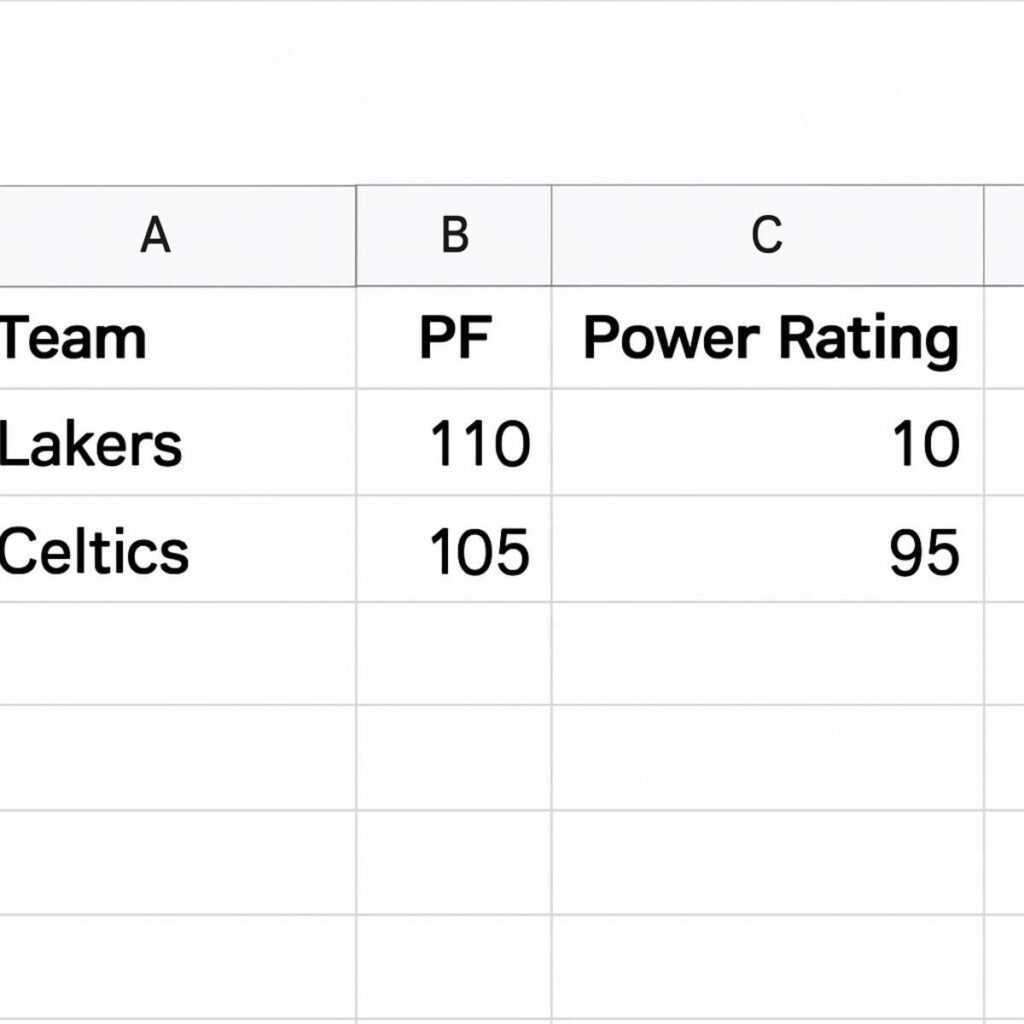
Your spreadsheet should look something like this simple NBA prediction model example:
As you can see, the Celtics’ Power Rating of +8.5 means they outscore their opponents by an average of 8.5 points per game. The Lakers’ rating of -0.6 shows they are typically outscored by a slight margin. This number gives you a much clearer picture of team strength than just looking at their win-loss record.
Congratulations, you’ve just built the core of a sports model! This Power Rating already gives you a data-driven edge. But what about one of the biggest factors in sports? Our current model treats a game in Boston the same as a game in Los Angeles. Next, we’ll add a simple tweak to account for the all-important home-field advantage.
The Home-Field Advantage Factor: A Simple Tweak for a Smarter Model
We all know playing at home is a huge advantage. The crowd noise, the familiar turf, no travel fatigue—it all adds up. Yet, our current Power Rating doesn’t see any of that. It treats a road game against a tough opponent the same as a home game, which any sports fan knows isn’t right. To make our model smarter, we need to teach it about the power of home-field advantage.
So, how much is playing at home actually worth? While it varies by sport and even by stadium, a good rule of thumb for the NFL is that the home team gets a built-in edge of about 2.5 points. For our sports betting model, we’ll apply this as a simple bonus. Before a game, just add 2.5 points to the home team’s Power Rating. The visiting team’s rating stays the same. That’s it. This small adjustment instantly makes your ratings more realistic by accounting for where the game is being played.
This adjustment embodies the core principle of improving a model: adding layers that better reflect reality. Professionals might use complex tools like regression analysis for sports outcomes or build an advanced ELO rating system in sports betting to fine-tune these numbers, but the logic is identical. You’ve now accounted for team strength and location. With these game-specific ratings, you’re finally ready to make a prediction.
How to Predict a Game’s Score With Your New Model
So far, you’ve created team Power Ratings and accounted for Home-Field Advantage. These are the essential ingredients. Now it’s time for the payoff: combining them to create a prediction for a specific game. This is the moment where your abstract ratings become a concrete, actionable number that you can use to see the game in a whole new way.
The process is surprisingly simple arithmetic. First, find the home team’s Power Rating and add your Home-Field Advantage bonus (we used 2.5 points earlier). This new number is their “Game Day” rating. The visiting team’s Power Rating stays as is. The difference between the home team’s Game Day rating and the visiting team’s rating is your model’s predicted point spread. For a simple NBA prediction model example, if the home team’s rating is 6.5 (+2.5 HFA) for a total of 9.0, and the away team’s rating is 5.0, your model predicts the home team will win by 4 points (9.0 – 5.0).
Congratulations—that final number is the heart of your model. Remember, this isn’t just a random number; it’s your system’s independent opinion on how the game should unfold, built from the logic you just created. While professionals might follow a sports betting model python tutorial to have a computer run thousands of these calculations, the core logic they’re using is exactly what you just did by hand or in a spreadsheet.
You’ve successfully translated team performance data into a single, powerful prediction. But what does it mean if your model predicts the home team will win by 4 points, but the official sportsbook line is 7 points? This difference between your number and the market’s number is where the real fun begins. It’s the key to finding what bettors call “value,” and it’s exactly what we’ll explore next.
How to Find “Value Bets” Using Your Statistical Model
Now that you have your own predicted spread, you’ve reached the most exciting part of the process. You have an opinion that is based on data, not just a gut feeling. But how do you use it? The next step is to compare your prediction to the one set by the official sportsbooks. Think of the sportsbook’s point spread as the “market’s opinion” on the game. By putting your number next to theirs, you can instantly see where your logic disagrees with the crowd.
This difference between your betting model results and the sportsbook’s line is the core of what professionals call a “value bet.” For example, if your model predicts the home team will win by 4 points, but the sportsbook has them favored to win by 7.5 points, you’ve spotted a significant disagreement. Your model believes the game will be much closer than the market does. In this scenario, betting on the underdog to “cover the spread” (meaning, to lose by less than 7.5 points or win outright) would be considered a value bet. You’re wagering that your data-driven analysis is more accurate than the public line.
Finding value bets with a statistical model boils down to a simple, repeatable check. It’s a habit you can use for any game you analyze:
- Get Your Number: Run the teams through your model to get your predicted spread (e.g., “My model says Team A wins by 4”).
- Get Their Number: Look up the official point spread for the same game on any major sportsbook.
- Find the Gap: Compare the two numbers. If the difference is significant—say, 2.5 points or more—you’ve identified a potential value opportunity.
Crucially, this “value” is not a guarantee that your bet will win. Sports are unpredictable, and even the best models are wrong all the time. Instead, a value bet is one where you have a clear, logical, data-backed reason for making it. You’re not just guessing; you’re making an educated play based on a flaw you believe you’ve found in the market’s price. But this process can have its own traps, which is why it’s just as important to understand the common pitfalls new modelers face.
The Reality Check: Common Pitfalls in Predictive Modeling
Seeing your betting model results disagree with the sportsbooks is a thrilling moment. It feels like you’ve found a secret edge. But before you get too confident, it’s essential to understand the common pitfalls in predictive modeling. Acknowledging these blind spots is what separates a structured, intelligent approach from simply guessing with extra steps. Your model is a fantastic starting point, but it’s not foolproof.
The most common trap is trusting your numbers when they’re based on too little information. Imagine it’s Week 3 of the NFL season. If a team has won their first two games by a huge margin, your model will likely rate them as one of the best in the league. However, it can’t tell the difference between a genuinely elite team and an average one that just had a lucky start against weak opponents. A model is only as smart as the data you feed it, and two games are barely a snack.
Furthermore, a simple statistical model is completely blind to crucial, real-world context. Think about what happens when a star player gets injured in practice the day before a game. Your model, which is based on weeks of data with that player on the field, still thinks the team is at full strength. It can’t read the news. This is where your own knowledge as a fan is irreplaceable; you must be the one to step in and adjust your expectations when something significant happens that the numbers can’t see.
Ultimately, it’s vital to remember that your model is a compass, not a GPS. Its purpose is to point you in the direction of potential value, not to give you a guaranteed winning ticket. Resist the urge to treat every small disagreement as a must-be opportunity. The goal isn’t to build a perfect prediction machine, but a tool that helps you think more critically about why you’re making a bet. This constant process of checking your model against reality is the true path to getting smarter.
Beyond the Basics: What’s the Next Step for Your Model?
Your new model is a fantastic starting point, but it has a blind spot: it treats all opponents equally. A 20-point win against the worst team in the league looks the same as a 20-point win against a championship contender. This is where the concept of Strength of Schedule comes in. Think of it like a student’s report card; getting an ‘A’ in an easy elective isn’t as impressive as getting a ‘B’ in an advanced physics class. By adjusting team ratings based on the quality of their competition, you begin to see a truer picture of their actual strength.
Another way to add nuance is by considering a team’s style. In basketball, is a team that scores 115 points in a frantic, up-and-down game truly better than a team that scores 100 in a slow, methodical half-court battle? Raw points can be misleading. That’s why analysts look at Pace of Play, which measures how many possessions a team uses. By adjusting for pace, you’re no longer comparing apples to oranges; you’re looking at a team’s efficiency—how many points they score per chance—which is a much fairer comparison.
Adding these layers is how you graduate from a simple calculator to an insightful tool. This is the exact path professionals follow, though they use more powerful techniques. You might hear them discuss using a Poisson distribution for football predictions to better handle low-scoring outcomes or leveraging machine learning for sports wagering to find hidden patterns. They might even debate poisson vs regression for betting. But the core principle is exactly what you’re doing now: asking smarter questions to add context to the numbers. You’ve started thinking like an analyst.
You’ve Built a Model: Now You’re Thinking Like an Analyst
Before you read this, you likely relied on gut feelings or what the experts on TV were shouting. Now, you possess the framework to move beyond the noise. You’ve seen how to take simple game scores, transform them into a meaningful Power Rating, account for home-field advantage, and generate a prediction that is entirely your own. You didn’t just learn a process; you built a new lens for analyzing the game.
The real excitement begins now. True sports betting success at this stage isn’t about profit; it’s about the process of analyzing data to build a more informed opinion. Your clear first step is to apply this to a league you love. Open a simple spreadsheet for next week’s games and start tracking your ratings. See what the numbers tell you before anyone else does.
When your prediction differs from the official betting line, that’s your key to interpretation. Don’t just ask who is right; ask why they are different. Is the public overvaluing a team after a big win? Does your model see a weakness that the narrative is ignoring? Each comparison sharpens your thinking.
You’ve fundamentally changed your relationship with the game. You’re no longer just a fan reacting to the headlines; you are an analyst with a system. The goal was never to build a perfect crystal ball, but to earn a more rewarding understanding of the sports you love. You now have a reason for your beliefs, and that is a more powerful way to watch the game.